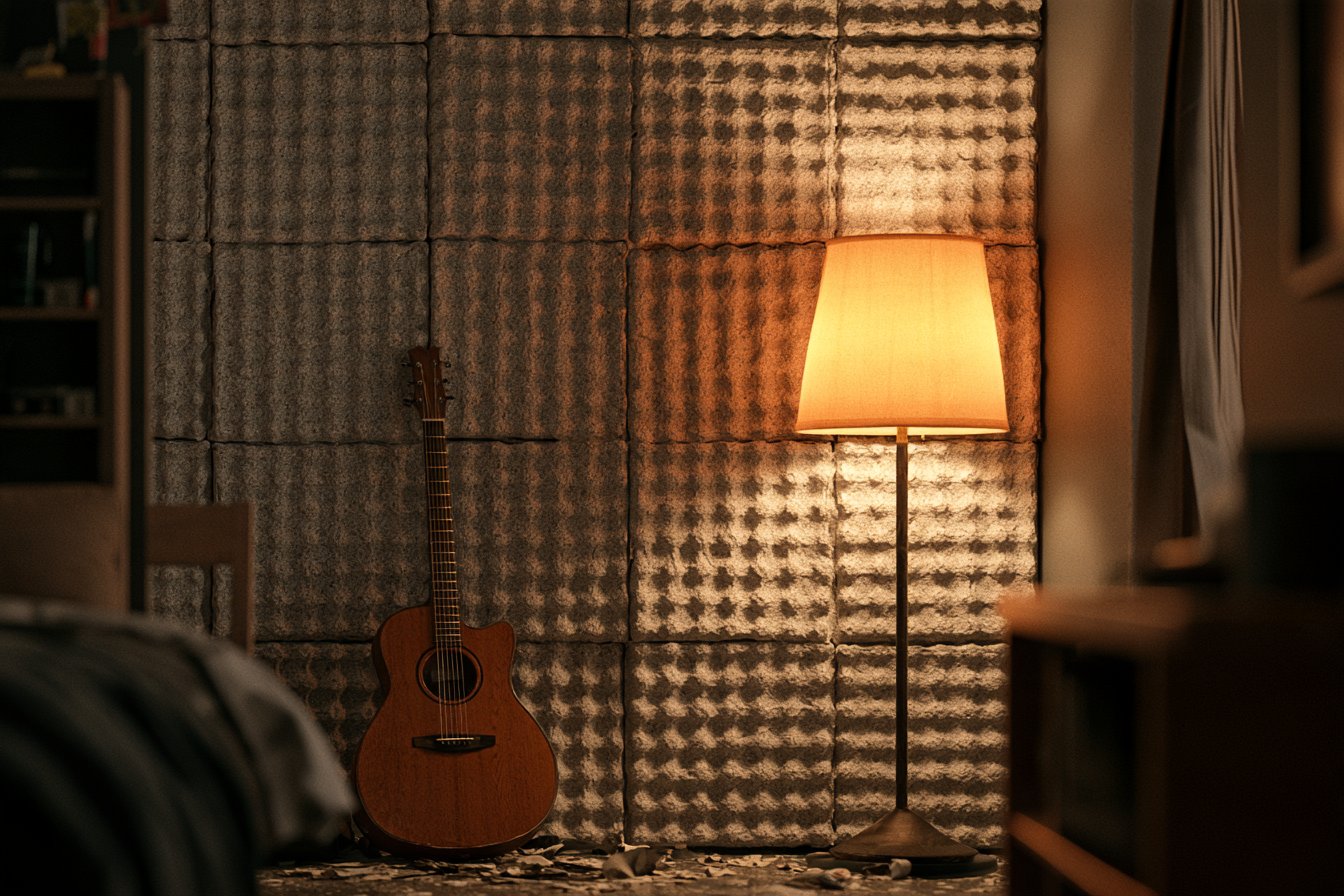
Egg cartons on the wall is one of the oldest dorm-room hacks: free, a bit punk, and supposedly the cheap way to soundproof a room. People who test acoustic materials for a living have actually put egg cartons in a lab, and the result surprises both sides. The cartons are better at one job than most debunking articles admit, and useless at the job you probably want them for.
Short answer: No, egg cartons don’t soundproof a room. Soundproofing means blocking sound from passing through a wall, and that takes mass and airtight seams. A wall of cartons weighs about 0.24 to 0.38 lb per square foot, while a single sheet of regular drywall weighs 1.6. What cartons can do is absorb echo inside your room. In a 2023 lab test, closed cartons scored an NRC of up to 0.80, but they did almost nothing for bass, and they’re paper on your wall. If a neighbor’s noise is the problem, seal the gaps around doors and windows instead.
Disclosure: this post contains affiliate links, and as an Amazon Associate I earn from qualifying purchases. If you buy through them I may earn a small commission at no extra cost to you. I only recommend things I would use in my own home.

Blocking and Absorbing Are Two Different Jobs
Almost every egg carton argument comes from mixing up two things:
- Blocking stops sound from getting through a wall, floor or door, so your neighbor’s TV stays on their side. It’s rated in STC (Sound Transmission Class). Higher means less gets through.
- Absorbing soaks up sound that’s already in your room, so it doesn’t bounce around. That’s the difference between an echoey empty apartment and the same room with a rug, curtains and a sofa. It’s rated in NRC (Noise Reduction Coefficient), from 0 (reflects everything) to about 1 (absorbs almost everything).
Soft, light, bumpy materials are good at absorbing. Heavy, dense, airtight materials are good at blocking. Egg cartons are light, bumpy and full of holes, so if they help at all, it’s with the first job. The rule of thumb: if the noise starts in your room, absorb it. If it comes from next door, block it.
What the Lab Test Actually Found
In March 2023, Riverbank Acoustical Laboratories, an accredited acoustics lab, tested 216 pressed paper pulp egg cartons under ASTM C423, the standard test for sound absorption. They tried four layouts, each laid directly against the test surface, about 72 sq ft of cartons in total. Here’s what came back:
| Layout | Absorption at 125 Hz (bass) | At 250 Hz | At 1000 Hz | NRC |
|---|---|---|---|---|
| Closed, upside down | 0.12 | 0.74 | 0.73 | 0.80 |
| Closed, staggered | 0.10 | 0.45 | 0.91 | 0.80 |
| Closed, right side up | 0.10 | 0.10 | 0.98 | 0.55 |
| Trays only, lids off, upside down | -0.03 | 0.06 | 0.65 | 0.50 |
Two things stand out. First, closed cartons absorb mid and high frequencies surprisingly well. An NRC of 0.80 is a respectable number for an absorber. Second, every layout is close to useless for bass, and the open trays people actually glue to walls did worst of all. A trays-only wall does basically nothing below 250 Hz, which is where the thump of music, footsteps and a neighbor’s TV lives.
What Riverbank didn’t test is the question in the title: how much sound egg cartons stop from passing through a wall. Its report covers absorption only, with no transmission loss and no STC. That’s not an oversight. A sheet of paper pulp full of air pockets was never going to be a barrier.

Source check: “egg cartons soundproof a room”
What the internet says: line a wall with egg cartons and you’ll stop noise from getting in or out. Or the opposite: egg cartons do nothing at all.
What the tests actually say: both are wrong. Riverbank’s 2023 reports measured NRC 0.50 to 0.80 depending on the layout, so the cartons do absorb, but barely at all at 125 Hz. An older test by Acoustics First, also at Riverbank, measured NRC 0.40 with an uneven curve. Neither test looked at blocking, which is what “soundproofing” means.
What I’d do: skip the cartons either way. For echo, a rug and curtains do the same job without paper on the wall. For a noisy neighbor, start with the gaps around your door.
Why Cartons Can’t Block Your Neighbor’s Noise
Two things decide how much sound gets through a wall: how heavy it is and how airtight it is.
Weight. Physics gives heavier panels a big advantage. A National Research Council Canada digest on sound transmission puts it this way: for a large thin panel, sound insulation “would theoretically increase by 6 dB for each doubling of the sound frequency or the mass.” The closed cartons Riverbank tested weighed 0.38 lb per square foot, and the trays about 0.24. One sheet of regular 1/2-inch Gold Bond drywall weighs 1.6, four to seven times more. Your wall already has drywall on each side. A layer of cartons adds almost nothing to it.
Gaps. Sound goes wherever air goes. The same NRC Canada digest, about windows, warns that “transmission of sound through cracks may drastically reduce the effective noise reduction,” and that even well-weatherstripped windows lose some insulation to air leaks. That’s why the gap under your door or around a window frame often lets in more noise than the whole wall. It’s also why sealing gaps is the one fix a renter can do that’s close to real soundproofing.
For context, walls and floors between apartments are held to a building code number. According to National Gypsum, the International Building Code requires a lab-tested STC of at least 50 (45 when tested in the field) between dwelling units. If you can clearly hear normal conversation next door, the problem is usually a gap or a weak spot like an outlet box, a door or a shared duct, not a wall that needs cardboard.

The Part Nobody Mentions: It’s Paper on Your Wall
Egg cartons are dry pressed paper, and covering a wall with them means covering a wall with kindling. Acoustics First puts it bluntly, quoting acoustician Nick Colleran: “Take an egg carton outside and put a match to it!”
The same goes for the other dorm favorite, the egg crate foam mattress topper. Foam sold as bedding isn’t made or rated to cover walls. The deadliest example is the 2003 Station nightclub fire in Rhode Island, where, according to NIST’s investigation, pyrotechnics ignited polyurethane foam lining the walls and ceiling around the stage, and 100 people died. NIST later recommended banning non-fire-retarded flexible polyurethane foam from nightclubs altogether. Your bedroom isn’t a nightclub, but the material doesn’t know that.
If you want something on the wall to tame echo, buy acoustic panels sold with a fire rating, usually listed as Class A under ASTM E84, and check the listing before you order.
Quick check
What’s actually bothering you?
Pick the noise. Each one has a different fix, and only one of them is a job for something soft on the wall.

What Actually Helps in a Rental
None of this turns an apartment into a recording studio, but all of it is cheap, removable and aimed at the right problem. Start with whatever matches your noise.
Start here
A door sweep or under-door draft stopper
The gap under an apartment door is often the biggest hole in your room. Closing it costs less than a pizza and cuts hallway noise and drafts at the same time. Stick-on sweeps go on the door itself; slide-on stoppers need no adhesive at all.
Worth it if: you can see light under your door, or hear the hallway clearly.
Skip it if: the noise comes through a wall or ceiling, not the door. Also check that the door still clears your rug when it swings.
Self-adhesive weatherstripping for the door frame and windows
Foam or rubber strips seal the sides and top of a door and the gaps around old window sashes. Worth it if street noise or drafts come in around the window. Skip it if your lease forbids adhesives on frames; test a small piece first, since some adhesives pull paint when they come off. Browse weatherstripping on Amazon
A big rug with a dense felt pad
The best echo fix for a bare room, and the kindest thing you can do for the neighbors below. Worth it if your room echoes or you live above someone. Skip it if the noise is coming in from outside, since a rug won’t stop that. I’ve covered which rug pad to choose separately. Browse felt rug pads on Amazon
Fire-rated fabric acoustic panels
What egg cartons wish they were: made to absorb, with a fire rating. Worth it if you take calls, record or play music and the room sounds hollow. Skip it if you’re hoping to block a neighbor. Panels absorb, they don’t block, just like the cartons. Look for Class A in the listing, and use removable hanging strips rated for the weight. Browse fire-rated acoustic panels on Amazon
A white noise machine
It doesn’t block anything. It makes the noise you can’t stop less noticeable, especially at night. Worth it if the problem is footsteps or a neighbor’s TV you can’t do anything about. Skip it if steady background sound keeps you awake. Browse white noise machines on Amazon

When DIY Quieting Isn’t the Right Call
- You can hear normal conversation through the wall: that points to a gap or a building problem. Ask the landlord to check outlets, shared ducts and the door seal before you spend money.
- The noise is bass or footsteps: nothing removable on your side fixes low-frequency or structural noise. Mask it, talk to the neighbor, or factor it into the next move.
- You’re thinking of building a room inside the room: for a real home studio, decoupled walls and extra drywall need an acoustician, a contractor and, in a rental, written permission.
- You’re about to cover a wall in cardboard or mattress foam: please don’t, especially near a radiator, lamp or outlet. It’s a fire load with little acoustic payoff.
Questions People Ask
Does egg crate foam soundproof a room?
No. Egg crate foam, whether it’s a mattress topper or a studio panel, is an absorber. It reduces echo inside the room but blocks very little going through the wall. Bedding foam also isn’t made or rated for walls, so it’s a fire risk there.
Do egg cartons reduce echo?
Somewhat, at mid and high frequencies. In Riverbank’s 2023 tests, closed cartons scored an NRC of 0.55 to 0.80 depending on how they were laid, and open trays 0.50. None of the layouts did much for bass. A rug, curtains and soft furniture give you the same benefit without paper on the wall.
How many egg cartons would it take to soundproof a room?
There isn’t a number, because adding more cartons doesn’t make them a barrier. Blocking depends on mass and airtightness, and a wall of cartons weighs a fraction of a single sheet of drywall.
Are egg cartons on the wall a fire hazard?
They’re dry paper with lots of air around them, so yes, they add fuel to a room. Keep them, and any foam not sold as fire-rated, away from walls, especially near heaters, lamps and outlets.
What’s the cheapest way to soundproof an apartment as a renter?
Seal the gaps: a door sweep or draft stopper and weatherstripping around doors and windows. It’s the only cheap, removable fix that actually blocks sound. Then add a rug and curtains for echo, and a white noise machine for what’s left.
A quieter room is the first step to a calmer one
My free Cozy Home Starter Checklist walks through the small changes that make a place feel like yours. One printable page.
Get the free checklist
The Bottom Line
Egg cartons don’t soundproof anything. Blocking sound takes mass and airtight seams, and cartons have neither. They do absorb some echo, more than their reputation suggests when they’re closed, but almost nothing in the bass, and they put paper on your wall. For a noisy hallway or street, seal the gaps first. For an echoey room, add a rug, curtains and, if you need them, fire-rated panels. For a noisy neighbor, mask it and talk to them or the landlord. Keep the cartons for the eggs, or the recycling.
Sources
- Riverbank Acoustical Laboratories, Novelty Test Report IV: Egg Cartons, reports A23-068 to A23-071 (ASTM C423, tested March 28, 2023)
- Acoustics First, The Infamous Egg Carton Test
- J.D. Quirt, Sound Transmission Through Windows, Canadian Building Digest CBD-240, National Research Council Canada
- National Gypsum, Understanding acoustical assemblies
- National Gypsum, Gold Bond Gypsum Board submittal sheet
- NIST, Station Nightclub Fire (2003)
Last checked October 30, 2026: absorption coefficients, NRC, layouts and weights against all four Riverbank reports; the Acoustics First NRC and quote; the CBD-240 quotes on mass and cracks; the IBC STC figure via National Gypsum; the drywall weight on the Gold Bond submittal; and the Station fire details on NIST’s page. The weight comparison is my own math from those figures.
Keep reading
- The Rug Pad Question Is Really Four Questions
- How to Layer Sheer and Blackout Curtains: Which Goes in Front Depends on the Room
- No Drill Curtain Rods: Pick the One That Fits What’s Around Your Window
- Removable Only If Your Wall Agrees: Peel and Stick Wallpaper in a Rental
- Minimalist Scandinavian Decor for Renters: No-Damage Ideas
- Cozy Industrial Home Office Ideas for Small Apartments
Meet Sofie
Hi, I’m Sofie, the voice behind Cozy Home Vibes. I write for people who want a home that feels warm and lived-in without a designer budget. Before I recommend anything, I read the size charts, care labels and manufacturer fine print, so you can skip that part and get straight to the cozy.
Free printables, first
Want my next printable and new cozy guides in your inbox? One short email when something new is out, no spam, unsubscribe anytime.


Leave a Reply