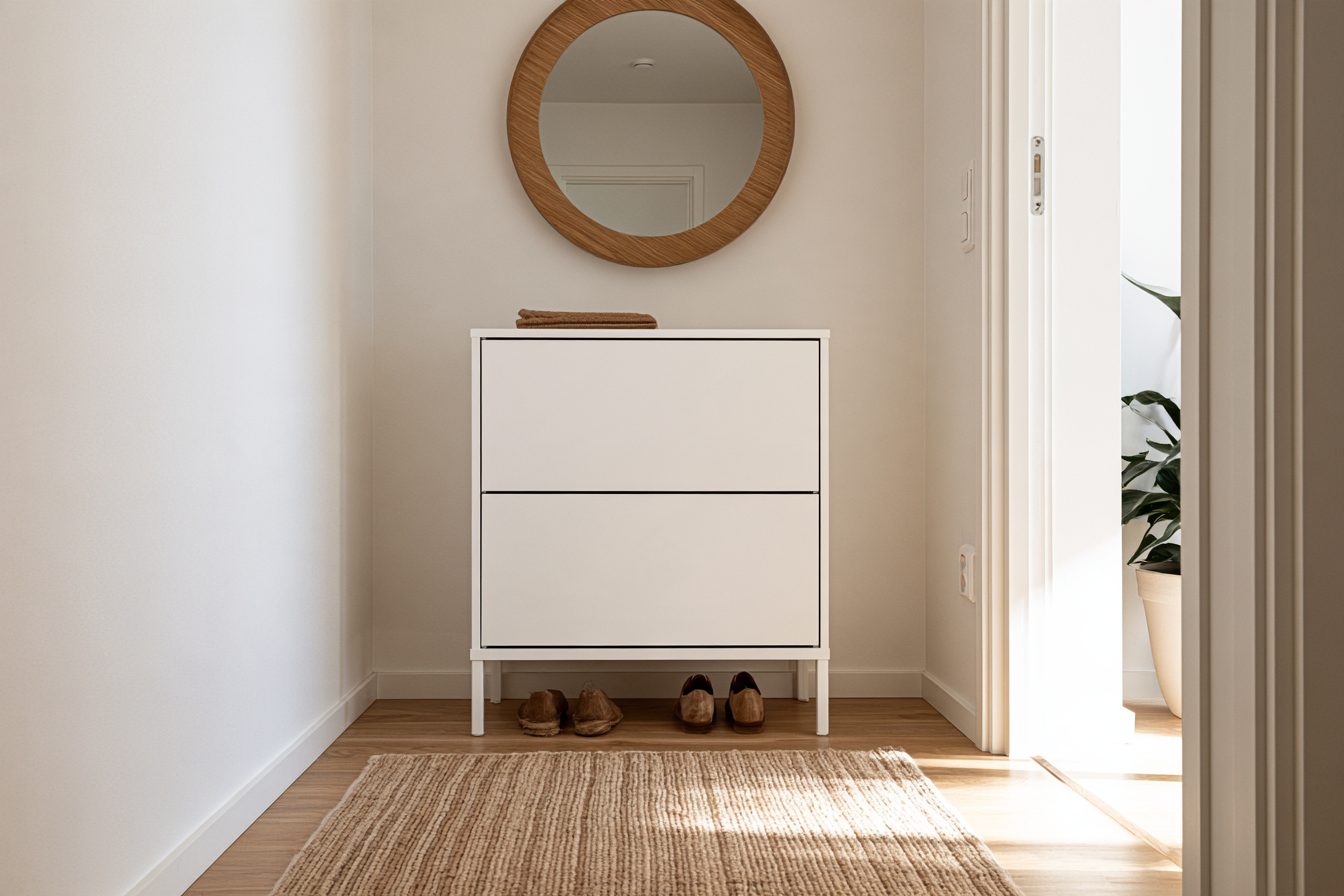
A slim shoe cabinet is sold by its depth, but the number that decides whether it works is the width of your hallway. Every listing says “narrow” or “space-saving”. Very few of them tell you how much floor you will have left to walk on once it is against the wall. In a hallway built to the 3 foot code minimum, the difference between a 7 inch cabinet and a 12 inch one is the difference between walking past it and turning sideways.
So this guide starts with a tape measure, not a product. Then it explains why a flip-drawer cabinet barely 9.4 inches deep can still take a pair of size 12 boots.
Short answer: Measure your hallway, subtract the cabinet’s depth, and look at what is left. In a 36 inch hallway (the minimum in the International Residential Code), a 9.4 inch flip-drawer cabinet leaves about 26.6 inches to walk through, a 7 1/8 inch cabinet like IKEA TRONES leaves about 29, and a 12 inch shelf cabinet leaves 24 (my math). Flip drawers hold shoes tilted, which is why 9.4 inches can fit large shoes. Whatever you choose, anchor it to the wall.
Disclosure: this post contains affiliate links, and as an Amazon Associate I earn from qualifying purchases. If you buy through them I may earn a small commission at no extra cost to you. I only recommend things I would use in my own home.
How Deep Is a Slim Shoe Cabinet?
“Slim” is not a standard size. Here is what four real listings say, measured the way the sellers measured them. I picked them to show the range, not as a ranking.
| Cabinet | Depth | Width x height | What the listing says it holds | Anchoring |
|---|---|---|---|---|
| IKEA TRONES (wall or floor) | 7 1/8 in | 20 1/2 x 15 3/8 in | “approx. 4 pairs of shoes” | “must be secured to the wall” |
| HOOBRO 2 flip drawers | 9.4 in | 31.5 x 40.5 in | no pair count; divider comes out for “winter boots and leather high-top shoes” | not in the official specs |
| BORNOON 3 flip drawers (Amazon listing) | 9.45 in | 31.5 x 47.2 in | no pair count in the title | check the listing |
| 4 flip drawers (Walmart listing) | 9.4 in | 47.2 x 38 in | “Holds 25–45 pairs”, “everyday sneakers to size 12 boots” | anti-tip kit included |
Depths and quotes from the product pages, checked November 13, 2026. Prices change too often to list.
Two things stand out. First, all three flip-drawer listings sit at 9.4 to 9.45 inches, so “slim” in practice often means about 24 cm. Second, the capacity claims are wide: one listing says 25 to 45 pairs for the same box. That range is honest, though. A pair of kids’ sneakers and a pair of men’s boots do not take the same space, so count with your own shoes, not the listing.
Start With the Hallway: What Is Left to Walk On
The International Residential Code, section R311.6, says “the minimum width of a hallway shall be not less than 3 feet” (as quoted in a Richmond, Kentucky code handout). If your hallway was built to that line, 36 inches is the worst case to plan for.
For comparison, the ADA Standards ask for a walking width of “36 inches (915 mm) minimum” in public buildings. That rule does not apply inside your home. Still, it is a useful yardstick: it is the width someone decided a person needs to walk comfortably. Any cabinet in a code-minimum hallway takes you below it, so the real question is how far.
| Hallway width | 7 1/8 in cabinet | 9.4 in cabinet | 12 in cabinet |
|---|---|---|---|
| 36 in (code minimum) | 28.9 in left | 26.6 in left | 24 in left |
| 40 in | 32.9 in left | 30.6 in left | 28 in left |
| 42 in | 34.9 in left | 32.6 in left | 30 in left |
| 48 in | 40.9 in left | 38.6 in left | 36 in left |
My math: hallway width minus cabinet depth. Measure at the baseboard, because that is where the cabinet will stand.
My rule of thumb: in a 36 inch hallway, stay at 9.4 inches or less. From about 42 inches, a 12 inch cabinet still leaves 30 inches, and you can choose by style instead of depth. Also watch the door. If a door swings into the hallway, keep the cabinet out of that arc, or the door will hit it every single day.
Hallway calculator
How deep can your shoe cabinet be?
Measure the hallway at the baseboard where the cabinet will stand. Use the depth from the listing.
Flip Drawers vs Shelves: Why 9.4 Inches Holds Big Shoes
A shelf cabinet stores shoes flat, heel to toe, so it has to be at least as deep as your longest shoe. A flip drawer stores them standing at an angle. The drawer tips forward, you drop the shoes in toe down or heel down, and they lean against the back.
That angle is the whole trick. A 12 inch shoe standing at 45 degrees takes about 8.5 inches of depth (my math: 12 × 0.71), which is why the Walmart listing above can claim “everyday sneakers to size 12 boots” in a 9.4 inch box. The cost is height: the same tilted shoe also needs about 8.5 inches of drawer height, so tall boots and high-tops are where flip drawers struggle. HOOBRO’s answer is a removable divider for “winter boots and leather high-top shoes”.
- Flip drawers: the slimmest option for everyday shoes and sneakers. Before you trust a pair count, check how many of your own shoes fit across one drawer.
- Shelves: better for boots, heels you don’t want to scuff and anything bulky, but you need the full shoe length in depth.
- Mixed households: a flip-drawer cabinet for daily pairs plus a boot tray by the door works better than one deep cabinet for everything.
Source check: do shoes need 12 inches of depth?
What the internet says: One detailed depth guide says adult shoes need “about 12 inches (30 cm) of clear internal depth” to lie flat.
What the sources say: That is right for shelves. Flip-drawer listings at 9.4 inches, like the Walmart one above, say they take sneakers up to size 12 boots, because the shoes stand tilted instead of lying flat.
What I’d do: If your hallway is 36 to 40 inches wide, pick flip drawers and keep the boots elsewhere. If it is wider, a 12 inch shelf cabinet is fine and easier to fill.
Anchor It, Even If It Feels Steady
A slim cabinet is tall and shallow, and an open flip drawer moves its weight forward. IKEA’s TRONES page says plainly that the cabinets “must be secured to the wall”. The federal Anchor It campaign goes further: “Anchoring all furniture with drawers, doors, and shelves to the wall prevents tip-over injuries and deaths.”
Some cabinets ship with an anti-tip kit; the 4-drawer Walmart listing says it includes one. If yours doesn’t, a furniture strap costs little and takes a few minutes. Use fasteners that suit your wall, because drywall, plaster and brick each need different ones.

What I’d Buy for a Narrow Entryway
These are types, not one brand, because the same cabinet is sold under many names. The links go to Amazon searches. Check the depth in the listing against the calculator above before you order.
Most hallways
Slim shoe cabinet with 2 flip drawers, about 9.4 in deep
The default for one or two people. It leaves about 26.6 inches in a 36 inch hallway, the top works as a landing spot for keys, and it is short enough to keep a mirror above it.
Worth it if: your hallway is 36 inches or wider and most of your shoes are sneakers and flats.
Skip it if: you mostly wear tall boots. Then a shelf cabinet or a boot tray fits better.
Families
Tall 4-drawer flip cabinet, about 9.4 in deep
Same depth, twice the drawers. This is the one to anchor without fail: it is tall, narrow and heavy at the top once it is full.
Worth it if: you need room for a household’s daily shoes and can drill into the wall.
Skip it if: you rent and can’t anchor it. A tall, unanchored cabinet is the wrong place to save floor.
Very narrow halls
Shallow wall-mounted shoe cabinet, about 7 in deep
Mounted on the wall, it frees the floor entirely, which matters most in a hallway under 40 inches. Expect fewer pairs per unit.
Worth it if: every inch of floor counts, or you want to clean under it.
Skip it if: your walls can’t take screws.
Whatever you buy
Furniture anti-tip straps
The cheapest part of the setup and the one I would never skip. Get a pack, because the cabinet is rarely the only tall piece in the house.
Worth it if: your cabinet did not come with an anti-tip kit.
Skip it if: the kit in the box already fits your wall type.

When a Slim Shoe Cabinet Isn’t the Answer
- Your hallway is under 36 inches: skip floor furniture. Use a row of hooks and a wall shelf instead; my tiny entryway ideas show how to do it without a cabinet.
- Wet boots come in every winter day: they need to dry before they go in a drawer. A boot tray by the door does that job, as I explain in my Scandinavian entryway guide.
- You rent and can’t drill: pick a low, open shoe rack instead of a tall cabinet. Less height means less leverage if someone leans on it.
- The hallway is dark as well as narrow: a white or light wood cabinet disappears better, and a lighter wall helps more than any furniture. My hallway paint guide covers the colors.

Questions People Ask
Where should a shoe cabinet go in a narrow hallway?
Right by the door, on the wall the door does not swing toward, so it never blocks the door or the latch. If both walls are free, choose the side you pass on the way in, so shoes come off in one step.
Can a slim shoe cabinet hold high heels?
Often, yes. The 4-drawer Walmart listing says its adjustable panels fit “flats, mid-calf boots, or high heels”. Stiletto heels can catch on the drawer edge, so slide them in heel first.
How tall should a shoe cabinet by the front door be?
The listings above run from about 15 to 47 inches. A cabinet around 40 inches tall makes a good drop spot for keys and mail, and leaves room for a mirror above it.
What should go on top of a shoe cabinet?
One tray for keys and one small lamp or plant, then stop. Hang a mirror above it at the height I worked out in my mirror height guide, and the cabinet turns into a real entryway.
Free printable
Free Weekly Home Reset Checklist
A shoe cabinet only stays tidy if it gets a weekly sweep. This one-page checklist builds that five-minute habit for the entryway and every other room.
Get the free checklistThe Bottom Line
Measure the hallway before you shop. In a 36 inch hallway, a 9.4 inch flip-drawer cabinet leaves about 26.6 inches to walk, and that is about as deep as I would go. Flip drawers fit big shoes because they hold them tilted, but tall boots still need a tray or a shelf. Anchor the slim shoe cabinet, keep it out of the door swing, and even a narrow entryway can hold the shoes you wear every week.
Sources
- IRC R311.6 as quoted in a City of Richmond, KY means of egress handout
- U.S. Access Board: 2010 ADA Standards, section 403.5.1
- IKEA: TRONES shoe/storage cabinet
- HOOBRO: narrow shoe storage cabinet with 2 flip drawers
- Walmart: 4 flip-down drawer shoe storage cabinet, 9.4 in deep
- Anchor It (U.S. CPSC)
- Tray and Threshold: shoe cabinet depth
Last checked November 13, 2026: the IRC R311.6 and ADA 403.5.1 wording, and the depths, capacities and anchoring notes on the IKEA, HOOBRO and Walmart product pages. Hallway clearances and the tilt depth are my own math.
Keep reading
Meet Sofie
Hi, I’m Sofie, the voice behind Cozy Home Vibes. I write for people who want a home that feels warm and lived-in without a designer budget. Before I recommend anything, I read the size charts, care labels and manufacturer fine print, so you can skip that part and get straight to the cozy.
Free printables, first
Want my next printable and new cozy guides in your inbox? One short email when something new is out, no spam, unsubscribe anytime.


Leave a Reply