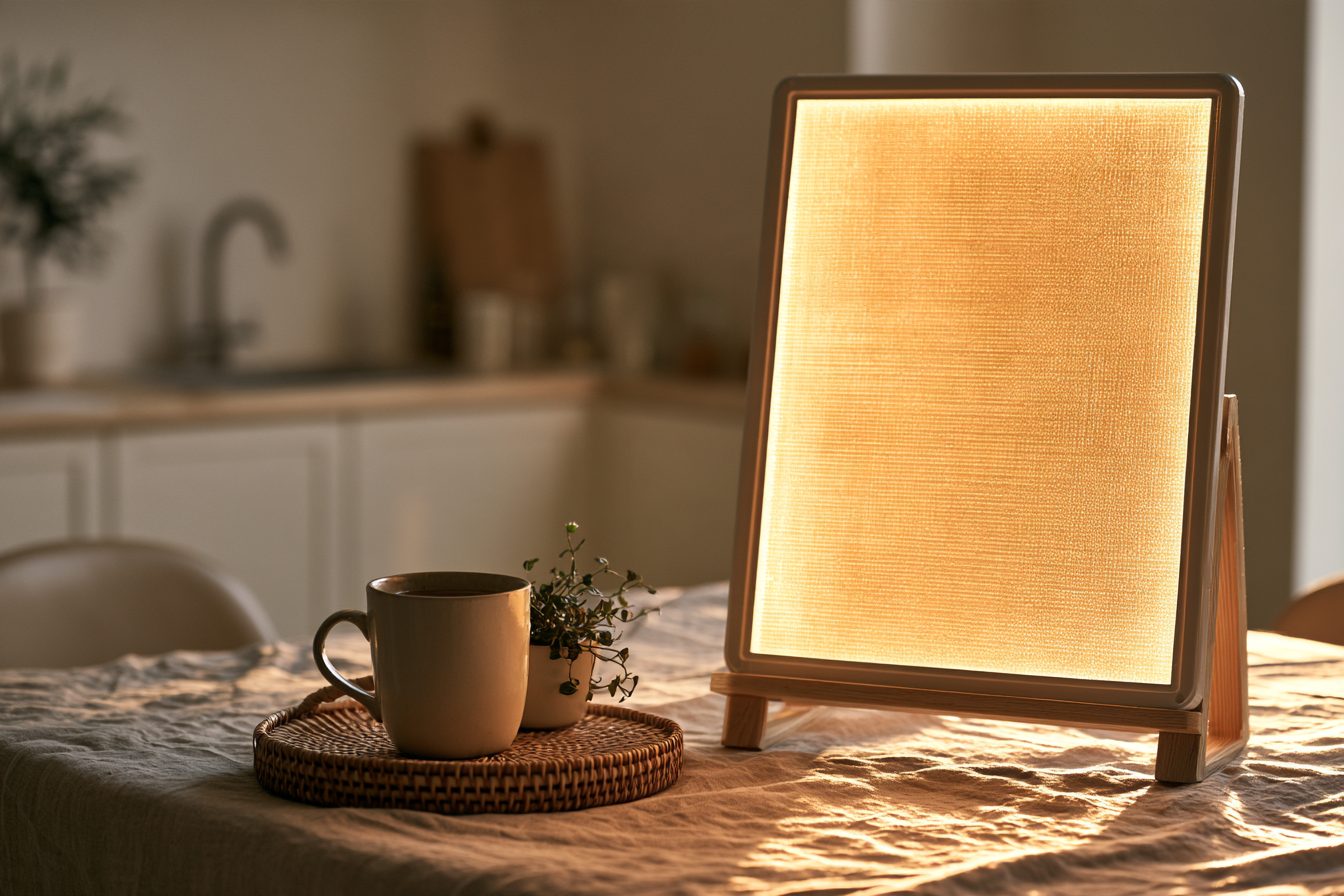
A SAD lamp is a bright light box that many people keep near the breakfast table from fall to spring. It works only where you actually sit, so where it goes in the room matters as much as which one you buy.
This is a decor and placement guide, not medical advice. I cover the one spec most listings bury, how far from your face the lamp should sit, and how to make a white glowing panel look like it belongs in a cozy home.
Short answer: Look for the distance printed next to the lux number. Cleveland Clinic suggests a spot on a desk or table, off to the side, about 16 to 24 inches from you. Yale’s light therapy program asks for at least 7,500 lux at about 11 inches, and one popular lamp, the Carex Day-Light Classic Plus, is rated at 10,000 lux at 12 inches. So buy for the distance you will really sit at, and if your spot is farther than the rating, choose a bigger panel. Talk to a health care provider before you start light therapy.
Disclosure: this post contains affiliate links, and as an Amazon Associate I earn from qualifying purchases. If you buy through them I may earn a small commission at no extra cost to you. I only recommend things I would use in my own home.
First, What This Guide Is and Isn’t
Light therapy is a treatment, so the health part belongs to your doctor. The National Institute of Mental Health describes it simply: a person “sits in front of a very bright light box (10,000 lux) every day for about 30−45 minutes, usually first thing in the morning, from fall to spring.”
Cleveland Clinic adds a clear warning: talk to your health care provider before starting. That applies especially if you have an eye condition such as macular degeneration, take certain medicines such as some antibiotics or anti-inflammatories, are sensitive to light, or have bipolar disorder.
Not medical advice. I write about decor, so everything below is about where the lamp sits and how it looks. Whether light therapy is right for you, and for how long, is a question for your health care provider.
With that settled, here is the part a decor blog can actually help with: the spot, the distance and the styling.

The Number That Matters: Lux at What Distance
Lux measures how much light lands on a surface, and it falls off fast as you move away. That is why a lux number means nothing without a distance next to it. Yale’s winter depression program says “any reputable company should provide clear specifications regarding the distance at which the device produces 10,000 lux.”
Yale also points out the trap. One major manufacturer, they write, “sells a device that is 10,000 lux at a distance of 6 inches,” which is “obviously” not practical for a 30 minute session. Six inches is closer than a laptop screen.
| What you read | The distance | Where it comes from |
|---|---|---|
| Place the light box off to the side | About 16 to 24 inches from you | Cleveland Clinic |
| At least 7,500 lux | At about 11 inches | Yale program criteria |
| At least 5,000 lux if your head moves | 5 inches left, right, up or down | Yale program criteria |
| 10,000 lux, 16 x 13 inch screen | At 12 inches | Carex Day-Light Classic Plus listing |
| 10,000 lux | At 6 inches | Yale’s example of an impractical rating |
Quotes and numbers are from the sources linked in each row and listed at the end. Cleveland Clinic also mentions boxes from 2,500 to 10,000 lux.
So the decision is simple. Measure where your face will be, then compare that with the rated distance on the listing. If the rating is closer than your seat, the lamp will give you less than the box promises.

Source check: “put a SAD lamp 16 to 24 inches away”
What the internet says: Any 10,000 lux lamp works if you keep it 16 to 24 inches from your face.
What the sources say: Cleveland Clinic does suggest “about 16 to 24 inches away,” off to the side. But lamps are rated at their own distance: the Carex Day-Light Classic Plus gives 10,000 lux “at 12 inches,” and Yale cites a device rated at only 6 inches.
What I’d do: Treat 16 to 24 inches as the comfortable range for a table, not a guarantee of brightness. Then follow the manufacturer’s distance, and if your usual seat is farther away, pick a larger panel instead of a small cube.
Placement check
Will Your Spot Work for This Lamp?
Find the distance printed next to the lux number on the listing. Then measure from your face, sitting as you usually do, to where the lamp would stand.

Where to Put a SAD Lamp, Room by Room
Cleveland Clinic recommends using it “as early in the day as possible,” so the best spot is wherever you already spend your first half hour. For most people that is the breakfast table, the desk or one chair.
| Spot | Why it works | Watch out for |
|---|---|---|
| Breakfast table corner | You sit still for 20 minutes anyway; the lamp can stand beside your plate | A wide table pushes it past its rated distance |
| Desk beside the monitor | Same seat every morning, easy to measure once | A monitor in front can block the light |
| Kitchen counter at a stool | Works for coffee and toast standing or perched | Splashes and steam; keep it away from the sink and kettle |
| Side table by a reading chair | Cozy and calm, pairs with a morning book | Side tables are low; you may need a taller stand |
| Bedroom vanity | You sit there to get ready | Mirrors bounce glare; angle it off to the side |
My take on each spot. The off-to-the-side rule is from Cleveland Clinic.
If you live in a small apartment, a breakfast nook is usually the winner. My guide to a cozy dining nook in a studio shows how to fit one table that does breakfast, work and dinner.

How to Make a SAD Lamp Look Less Clinical
Most light boxes are a white rectangle. That is fine for 30 minutes in the morning, but you still look at it the other 23 hours. So style the spot around it instead of hiding it.
- Give it a tray. A wooden or rattan tray with the lamp, a small plant and your mug turns a gadget into a morning corner. Lift the tray to clear the table for dinner.
- Choose a model with a stand or legs. Yale recommends units “with legs which elevate the unit,” and a raised lamp also looks more like furniture than a tablet lying flat.
- Match the cord to the wall. A white cord on a white wall disappears; a cord clip under the table edge does the rest.
- Keep the evening warm. The bright white panel is a morning tool. After dark, switch to warm lamps at 2700K, the low and golden light I describe in my Scandinavian lighting guide.
- Store it in plain sight. When the session ends, slide it onto a shelf next to books. Flat panels stand upright like a picture frame.
Small, dark homes get the most from this, because the morning corner is often the only bright spot. My tiny home lighting guide covers the rest of the room.

What I’d Look For in a SAD Lamp
Best for a breakfast table
Light box with a stand and a rated distance of 12 inches or more
A panel about the size of a large book, on an adjustable stand, sits at the corner of a table and angles toward you. The Carex Day-Light Classic Plus is one example, with a 16 x 13 inch screen rated at 10,000 lux at 12 inches.
Worth it if: you eat breakfast or work at the same table every morning.
Skip it if: you only have a narrow shelf or a nightstand to put it on.
Best for a desk
Slim panel that stands beside a monitor
A slimmer panel fits next to a screen. Read the listing closely. Small units can be rated as close as 6 inches, Yale’s example, and nobody sits that close to a desk.
Worth it if: your desk is your morning spot and space is tight.
Skip it if: the rated distance is much closer than your seat.
Best for a reading chair
Floor-standing light therapy lamp
A floor model puts the light at face height beside a chair, where a side table is usually too low. Check the rated distance and the height range.
Worth it if: your morning routine is coffee and a book in one chair.
Skip it if: you want to move it between rooms often.
Small helper
Plug-in outlet timer
A simple timer switches the lamp on at the same time every morning and off when your session ends, so it becomes part of the routine.
Worth it if: you want the lamp waiting for you, not another thing to remember.
Skip it if: your lamp has its own timer already.
When a SAD Lamp Isn’t the Right Buy
- You have an eye condition, take certain medicines, are sensitive to light or have bipolar disorder. Cleveland Clinic says to talk to your provider first. Start there, not with a cart.
- You want something to use all evening. The guidance is about the morning. For evenings, warm, layered lamps are the cozier choice; see my Scandinavian lighting guide.
- Your only free spot is far from where you sit. A lamp across the room will not reach its rated brightness. Move your morning routine to the lamp, or skip it.
- You were hoping for a brighter bedroom. A light box is not a room light. For a warmer, softer bedroom this winter, my winter bedroom decor guide is a better start.

Questions People Ask
Can I measure a SAD lamp’s brightness myself?
Yale mentions that phone apps for iPhone and Android can measure lux with the front camera. Treat the reading as a rough check rather than a lab number, and measure at the distance where your face will be.
Is a daylight bulb the same as a SAD lamp?
No. A daylight bulb describes the color of the light, not how many lux reach your face. Light boxes are rated in lux at a set distance, so the two cannot be compared on the box.
Should I pick blue light or white light?
Yale’s program writes that “at this time, we do not recommend treatment with blue light,” and the large boxes they discuss give white-appearing light. Ask your provider if you are unsure.
Does a SAD lamp give off UV?
Many are designed to filter it. The NIMH notes that light boxes filter out “the potentially damaging UV light,” and the Carex listing states “99.3% UV blocked.” Check the listing of the lamp you choose.
Free printable
Free Morning Routine Planner
Building a calmer winter morning around coffee, light and a few quiet minutes? This one-page planner helps you set the order once and stop thinking about it.
Get the free plannerThe Bottom Line
A SAD lamp only delivers its lux at the distance printed beside it. So measure your morning seat first: Cleveland Clinic suggests a spot off to the side about 16 to 24 inches away, and many lamps are rated closer, like 10,000 lux at 12 inches. Pick a lamp rated for your real distance, style the corner with a tray and a plant, keep warm lamps for the evening, and talk to your health care provider before you start.
Sources
Last checked November 14, 2026: placement distance and timing (Cleveland Clinic), light box criteria and the 6 inch example (Yale), session length and UV filtering (NIMH), Carex rated distance and screen size.
Keep reading
- Scandinavian Lighting Guide: Create a Cozy Hygge Glow
- Tiny Home Lighting: How to Make a Small Space Feel Brighter and Bigger
- Winter Bedroom Decor: Warm the Bed, Not the Room
- Cozy Reading Nook Ideas: 15 Hygge Corners
- Hygge Home Office Ideas: Cozy Tips to Boost Comfort and Productivity
- Winter Decor After Christmas: What to Keep Until March
Meet Sofie
Hi, I’m Sofie, the voice behind Cozy Home Vibes. I write for people who want a home that feels warm and lived-in without a designer budget. Before I recommend anything, I read the size charts, care labels and manufacturer fine print, so you can skip that part and get straight to the cozy.
Free printables, first
Want my next printable and new cozy guides in your inbox? One short email when something new is out, no spam, unsubscribe anytime.


Leave a Reply