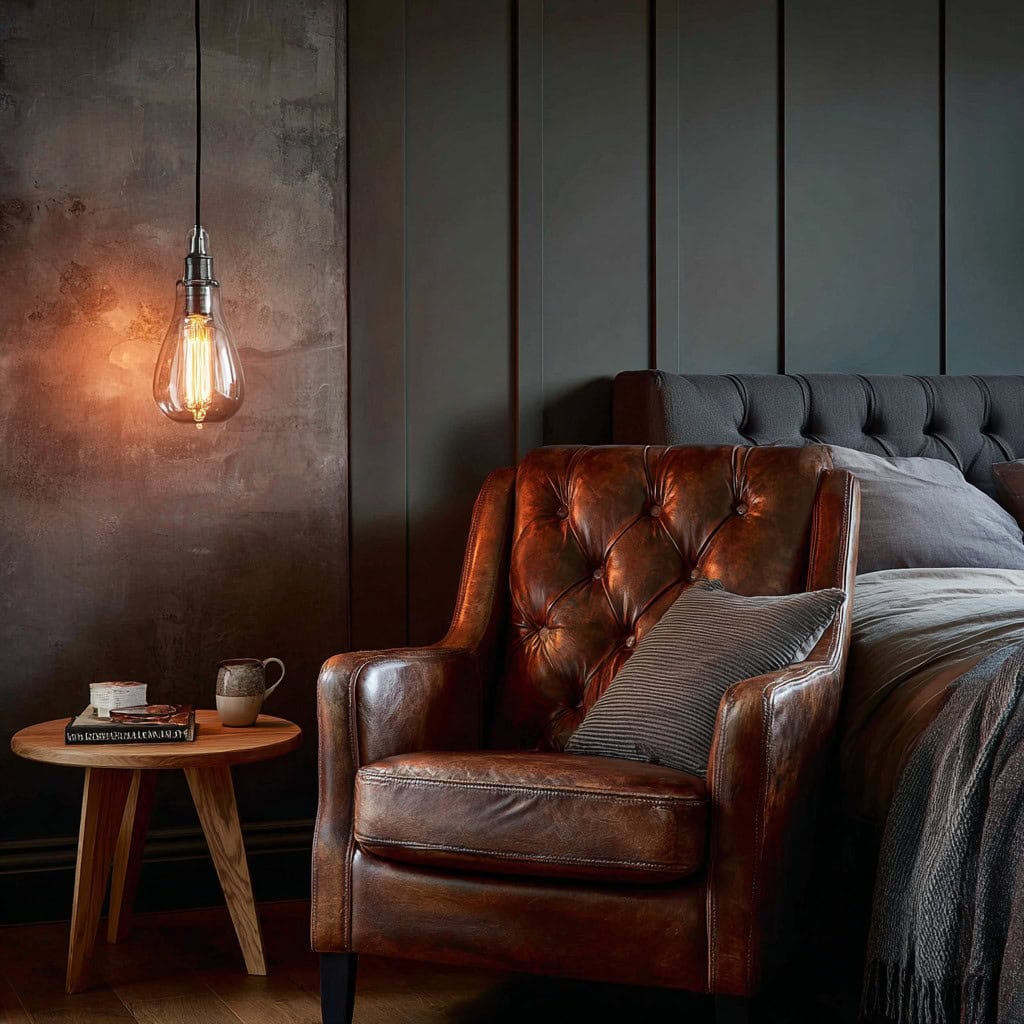
The short answer: to combine industrial and Scandinavian style, balance raw, rugged materials (exposed brick, black metal, concrete) with Scandinavian warmth (light wood, soft textiles, neutral tones). Start with a balanced neutral palette, mix materials intentionally, keep furniture simple and functional, layer warm lighting, and leave the layout airy. The two styles share a love of honest materials and clean lines, so they blend beautifully — industrial adds edge, Scandinavian adds warmth. Here’s how to get the balance right.
This post contains affiliate links. If you buy through them, I may earn a small commission at no extra cost to you. I only point you to the kind of pieces I’d put in my own home.

🏭 Quiz: What’s Your Industrial-Scandi Balance?
Answer 7 quick questions to find your blend of raw edge and Nordic warmth, and the one piece that gets you there.
The Core Elements of Each Style
Scandi industrial style, also called industrial Scandinavian, pairs the raw shell of a loft with the light, soft furniture of a Nordic home. On paper they look like opposites. In practice they share a quiet palette and a love of honest materials, which is why they blend so easily.
The table below puts the two side by side, and the last column shows what the mix looks like in a real room.
| Element | Industrial | Scandinavian | Scandi industrial mix |
|---|---|---|---|
| Palette | Charcoal, black, rust, brick red | White, light oak, greige, soft gray | White or greige walls, black only as an accent |
| Materials | Exposed brick, concrete, steel, leather | Light wood, wool, linen, ceramics | Steel frames with oak tops, a wool rug on a hard floor |
| Lighting | Bare bulbs, metal pendants | Soft, warm and layered | Black fixtures with warm white bulbs |
| Furniture | Heavy, angular, utilitarian | Low, light, rounded edges | Slim black legs, simple shapes, nothing bulky |
| Decor | Vintage finds, exposed structure | Plants, textiles, very little else | A few plants, one throw, clear surfaces |
My rule of thumb: one style is the base, the other is the accent.
In a bright apartment, let Scandinavian be the base, roughly two thirds of what you see, and add industrial through black metal and texture. In a dark loft with brick and concrete, flip it: the industrial shell is already there, so bring in light wood, white walls and soft textiles. The two thirds split is my own rule, not an official ratio, but it keeps the room from tipping into either a cold warehouse or a plain white box.
If your walls are the starting point, my Scandinavian color palette guide lists the neutral tones that work as a base. If the room already feels cold and hard, start with my ways to add warmth to industrial interiors.
To blend styles successfully, you need to understand what defines them:
Industrial Style:
- Raw materials (metal, concrete, brick)
- Dark, moody tones
- Exposed architecture (pipes, beams)
- Reclaimed or vintage elements
- Bold, utilitarian fixtures
Scandinavian Style:
- Light wood, white walls, and natural textures
- Soft neutrals (beige, gray, blush, sage)
- Simple, functional furniture
- Cozy elements (rugs, throws, candles)
- Emphasis on light and airiness
Think of industrial as the bones of a space, and Scandinavian as the soul.

Start with a Balanced Color Palette
Color is one of the easiest ways to create harmony between two styles.
Recommended palette:
| Base Colors | Accent Colors |
|---|---|
| Warm white | Black matte metal |
| Light gray | Charcoal |
| Taupe | Olive green |
| Sand beige | Rust or brick red |
Use Scandinavian tones as the base and industrial accents for contrast.
💡 Tip: Avoid too many harsh darks. Instead of painting full black walls, use matte black on light fixtures, legs of furniture, or decor.

Mix Materials with Intention
Blending materials is key to this hybrid style.
| Scandinavian | Industrial |
|---|---|
| Light oak | Reclaimed wood |
| Woven textiles | Concrete |
| Linen, wool | Metal (black, brass, steel) |
| Rattan | Brick or cement finishes |
Pair soft with strong. For every raw material (like concrete flooring), introduce a softening element (like a wool rug or sheepskin throw).

Keep Furniture Simple and Functional
Choose pieces that lean more toward Scandinavian minimalism but incorporate industrial features.
Living room:
- Mid-century sofa in gray or beige
- Coffee table with black steel legs + oak or walnut top
- Open shelving with wood + pipe structure
- Leather accent chair (worn or vintage)
Kitchen:
- Matte black bar stools with natural wood seats
- White or light cabinets with black handles
- Pendant lights in metal or glass
- Concrete-look backsplash or countertops
Bedroom:
- Platform bed in oak or black metal
- Linen bedding in neutral tones
- Wall-mounted lights or black sconces
- Industrial side tables or floating shelves
💡 Pro tip: Keep lines clean and low-profile, especially for larger furniture.

Layer Lighting for Mood and Function
Lighting can unify the two styles beautifully.
Tips:
- Use pendant lights with industrial frames over dining or kitchen areas
- Opt for Scandi-style table lamps in ceramic or light wood for the bedroom
- Wall sconces in matte black offer great flexibility
- LED strip lighting under shelves softens dark corners
- Choose warm white bulbs (2700–3000K) for cozy ambiance
Keep the Layout Airy and Open
Scandinavian design relies on space and light.
- Use open floor plans when possible
- Avoid clutter-everything should have a function
- Place furniture with room to breathe
- Use mirrors to bounce natural light
- Choose open shelving over closed cabinetry
Industrial design often emphasizes structure-but it doesn’t have to feel crowded. Think of walls and beams as architectural frames, not barriers.

Use Decor to Merge the Vibes
Accessories are where you can get playful while staying within the aesthetic.
Try:
- Neutral throw pillows in linen, paired with a leather or metal tray
- Black-and-white photography in simple wood frames
- Vintage industrial signs or maps next to Scandinavian ceramics
- Wool or jute rugs under metal-legged chairs
- Plants in concrete or metal pots to add life and softness
💡 Mix shapes too. Industrial is often sharp and angular; Scandinavian brings in roundness and calm curves.
Room-by-Room Styling Example
Living Room:
- Base: Light gray walls + white oak floors
- Industrial: Matte black pipe bookshelf, pendant light with wire cage
- Scandinavian: Cream sofa, wool rug, sheepskin over armchair
- Decor: Books, candles, framed art, concrete vase with eucalyptus
Kitchen:
- Base: White cabinets + black hardware
- Industrial: Concrete countertop + black steel shelves
- Scandinavian: Wooden bar stools, minimal dishes, warm lighting
- Decor: Linen tea towels, ceramics, potted herbs
Bedroom:
- Base: Beige linen bedding + natural oak bedframe
- Industrial: Black sconces + vintage clock
- Scandinavian: Minimalist side table + cotton throw
- Decor: Rattan tray, scented candles, abstract artwork
Want the bedroom to lean warmer and moodier? My guide to cozy industrial bedroom ideas covers paint colors, rug sizing and bedside lighting.

What to Avoid
Some mistakes can throw off the balance:
🚫 Too much dark metal – Makes the space feel heavy
🚫 Overly rustic elements – Tip into farmhouse, not industrial
🚫 Excess of minimalism – Ends up looking unfinished
🚫 Bright colors – Stick with earth tones and muted shades
🚫 Over-cluttering shelves or surfaces – Keep space intentional
Focus on balance and purpose-every item should feel considered.
Budget-Friendly Ways to Achieve the Look
Blending styles doesn’t need a massive budget. Try:
- Paint to unify mismatched furniture (matte black or soft gray)
- DIY pipe shelving for a statement wall
- Add peel-and-stick concrete backsplash
- Use fabric covers to soften metal chairs
- Shop Amazon or secondhand for mixable pieces
The easiest way to mix the two styles is to buy pieces that already mix them: black metal with light wood, raw texture with soft fabric. Each of these brings both halves into the room at once.
| Piece | Industrial half | Scandi half | Typical price |
|---|---|---|---|
| Faux sheepskin throw | Softens metal chairs | Pure hygge | $25 to $50 |
| Concrete planters | Raw concrete | Greenery, calm shapes | $25 to $50 for a set |
| Plug-in black wall sconce | Matte black metal | Warm, low light | $30 to $70 |
| Linen pillow covers in greige | Pairs with leather and metal | Soft, natural texture | $20 to $40 for a set |
| Wool and jute rug | Covers concrete or hard floors | Natural fibers | $120 to $300 |
| Oak and black metal coffee table | Steel frame | Light wood top | $120 to $300 |
| Pipe and wood bookshelf | Black pipe structure | Open, airy shelving | $100 to $250 |
Prices are typical ranges on Amazon and change often.
1. A faux sheepskin throw — the fastest softener
Draped over a metal or leather chair, it does exactly what the “pair soft with strong” rule asks for. Faux versions wash more easily than real hide.
Worth it if: your room has hard chairs or a leather sofa. Skip if: you have a dog that sheds on everything, a wool throw hides hair better.
Shop faux sheepskin throws on Amazon →
2. Concrete planters — raw meets green
Plants are the Scandinavian life in the room, concrete pots are the industrial frame. A set of two or three sizes lets you group them in odd numbers.
Worth it if: your plants live in plastic nursery pots. Skip if: you want to move big plants often, real concrete is heavy, lightweight fiberstone looks the same.
Shop concrete planters on Amazon →
3. A plug-in black wall sconce — edge with warm light
Matte black arm, warm 2700K bulb: it looks industrial and lights like a Scandinavian lamp. Plug-in versions need no electrician, which makes them renter-friendly.
Worth it if: you rely on a ceiling light in the evening. Skip if: there is no outlet nearby and you dislike visible cords, a black floor lamp does the same job.
Shop plug-in black sconces on Amazon →
4. Linen pillow covers in greige — the quiet layer
Greige, oatmeal or warm gray linen against a leather or dark sofa is the whole style in one corner. Covers are cheap and easy to change with the season.
Worth it if: your sofa pillows are bright or shiny. Skip if: your sofa is already light linen, add one rust or olive accent instead.
Shop linen pillow covers on Amazon →
5. A wool and jute rug — the floor that ties it together
On concrete or dark floors, a natural-fiber rug defines the seating area and adds the warmth Scandinavian rooms depend on. A blend is softer underfoot than pure jute.
Worth it if: you have hard floors and the room echoes. Skip if: it’s going under a dining table, jute traps crumbs, a flatweave washable rug is easier.
Shop wool and jute rugs on Amazon →
6. An oak and black metal coffee table — the anchor
The single piece that most clearly says “both styles”: a slim black steel frame with a light oak or ash top. Keep the shape simple and the legs thin.
Worth it if: your coffee table is glass, glossy or heavy. Skip if: you have small kids, sharp metal corners are a problem, a round wood table is gentler.
Shop oak and metal coffee tables on Amazon →
7. A pipe and wood bookshelf — structure that stays airy
Open shelving keeps sightlines clear, which is the Scandinavian half; black pipe uprights are the industrial half. Style it with fewer objects than you think: books, a plant, one ceramic piece per shelf.
Worth it if: you need storage but want the room to feel open. Skip if: you hate dusting, open shelves show everything, a closed sideboard with black legs is calmer.
Shop pipe and wood bookshelves on Amazon →
Find your blend fix in 3 taps
If you live in an actual loft, or an apartment with loft bones, the industrial half of this mix is already built in. Your job is mostly to frame it with Scandinavian softness and to plan the layout around the size of the space.
Highlight the architecture, then soften it
- Exposed brick: leave it raw for more edge, or whitewash it if you want it to lean Scandinavian. Whitewashed brick with light oak is one of my favorite combinations.
- Visible pipes or ductwork: paint them matte black or metallic silver so they look intentional.
- Concrete floors: keep them, and layer wool or shag rugs on top to define the seating area.
- Tall ceilings: hang long linen drapes close to the ceiling to stretch the vertical lines.
- Large factory windows: skip heavy curtains. Sheer gauze or linen lets the light in, which is the most Scandinavian thing you can do.
Choose plants that work with the scale
Loft rooms swallow small plants. I’d start with one tall floor plant, like a fiddle leaf fig or a palm, for vertical height. Add trailing pothos or ivy on a high shelf or along a beam, and use snake plants or ZZ plants if you want something nearly impossible to kill. Concrete or matte metal pots tie them to the industrial side. Group plants in odd numbers and vary their heights so they look collected rather than lined up.
Small loft vs. large loft
| Small loft | Large loft |
|---|---|
| Use glass or open shelving so nothing blocks the view | Define zones with rugs and furniture groupings |
| Float furniture away from the walls instead of lining the perimeter | Add an accent wall with paint or paneling to anchor one area |
| Hang mirrors to bounce light and widen the room | Use oversized artwork or statement lighting to fill the volume |
| Pick fewer, larger pieces over many small ones | Bring in tall plants or vertical storage to use the height |
In both cases, the rug does the heavy lifting on a concrete floor, because it draws the edge of the living area. Size it to the seating, not the whole loft: here is what size rug your living room needs.
Make it personal without breaking the look
Black-and-white photography or abstract art looks great against brick. Vinyl records, books and travel finds sit naturally on pipe-and-wood shelves, and a flea market piece or two keeps the room from looking like a catalog. Just keep the palette earthy so the personal pieces blend in instead of fighting the calm Scandinavian base.
Can you mix industrial and Scandinavian style?
Yes — they blend beautifully. Both styles value honest materials, clean lines, and functional design. Industrial brings raw materials and edge (brick, metal, concrete), while Scandinavian adds warmth and light (pale wood, soft textiles, neutral tones). Together they create a balanced space that’s characterful yet cozy.
What’s the key to blending the two without clashing?
Balance is everything. Pair each raw, hard element with a warm, soft one — concrete with wood, black metal with wool, dark tones with light. Keep a cohesive neutral palette, layer warm lighting, and leave the layout airy. Intentional contrast is what makes the mix work.
What colors work for industrial Scandinavian style?
Build on a warm neutral base — white, greige, soft grey, and beige — grounded by natural wood and accented with black metal or charcoal. This keeps the Scandinavian lightness while letting industrial elements add depth and contrast without overwhelming the space.
Is industrial Scandinavian good for small spaces?
Yes — the Scandinavian emphasis on light and minimalism keeps the look from feeling heavy, making it well-suited to small spaces. Use a light base, keep furniture simple and functional, and add industrial accents sparingly so the space stays open and airy.
Create Your Balanced Home — Free Printable
Blending industrial edge with cozy warmth? Our Cozy Home Starter Checklist guides your makeover room by room. Completely free, no signup wall.
↓ Download Cozy Home Starter ChecklistFree for personal use · One-page PDF · No signup required
Final Thoughts
🏭 Industrial by Room
🛁 Industrial Bathroom Design: Bold and Raw
🛏️ Cozy Industrial Bedroom Ideas
🍳 Industrial Kitchen Design Ideas
⚪ More on the industrial and Scandinavian mix
💰 Affordable Industrial Decor: Budget-Friendly Loft Style
🔥 How to Add Warmth to Industrial Interiors
📦 Small Industrial Spaces: Maximize Style
Industrial and Scandinavian styles aren’t opposites—they’re complements. Together, they balance rugged structure with warmth, moodiness with brightness, simplicity with soul.
To combine them successfully:
- Start with a neutral base
- Mix materials with contrast in mind
- Use simple furniture with clean lines
- Layer soft textiles over rough elements
- Let lighting and layout define the mood
- Style with purpose—not perfection
Your home should reflect you. And with this fusion, you’ll create a space that’s truly modern, grounded, and personal.


Leave a Reply