Most rug guides answer “what size rug for living room?” with the room. Measure the floor, they say, and buy the biggest rug that leaves a border. But walk into any living room where the rug looks wrong, and the problem is almost never the room. It’s the sofa. The rug that floats like a bath mat in front of a long couch is the most common way a living room ends up looking unfinished, and it happens in big rooms just as often as small ones.
Short answer: For most living rooms, an 8×10 rug is the right size. But two numbers decide it, not the room alone: the rug should be wider than your sofa by 6 to 8 inches on each side, and it should leave 12 to 18 inches of bare floor to the walls. With a standard 84-inch sofa, that means 8×10 in a medium room, 9×12 in a large one, and 6×9 in a small apartment, with the front legs of the sofa on the rug.
Disclosure: this post contains affiliate links, and as an Amazon Associate I earn from qualifying purchases. If you buy through them I may earn a small commission at no extra cost to you. I only recommend things I would use in my own home.
What Size Rug for a Living Room? Start With the Sofa
If you’re standing in a furniture store app right now, toggling between 8×10 and 9×12 and trying to picture both, here’s the shortcut. Forget the room for a second and measure your sofa from arm to arm. That number sets the minimum. The room only sets the maximum.
The rug’s long side should run parallel to the sofa and stick out past it on both ends. When it’s narrower than the sofa, the couch looks like it’s perched on a doormat. When it’s just a little wider, everything in the seating area suddenly belongs together. Then check the other direction: you want a frame of bare floor between the rug and the walls, so the rug reads as a deliberate island and not as wall-to-wall carpet that didn’t quite make it.
So the right living room rug dimensions are simply the biggest standard size that clears the sofa and still leaves that border. That is the whole secret of rug sizing for a living room, and in most homes it lands on 8×10. Honestly, if you’re unsure between two sizes, I’d almost always go one size up. A rug that’s slightly too big still looks intentional. A rug that’s too small never does.
Numbers worth knowing
- 6 to 8 inches: how far the rug should extend past each end of the sofa
- 12 to 18 inches: bare floor to leave between rug and walls; up to 24 inches in a big room
- 84 inches (7 ft): the length of a standard 3-seat sofa, the reason 8×10 is the default
- 6 inches: how far the rug should tuck under the front legs when only the front legs sit on it
- 2/3: the minimum rug length compared to the sofa when no legs touch it
- 1 inch: how much smaller the rug pad should be than the rug on every side
Quick quiz
Which rug size fits your living room?
Three questions. For exact numbers, use the calculator further down.
All Legs, Front Legs or No Legs: Rug Placement in a Living Room
Once you know roughly how big the rug can be, the next question is where the furniture goes on it. Whether you think of it as rug placement in the living room or simply placing a rug in the living room, every rug layout in the living room comes down to one of three options, and each one quietly decides the size for you.
| Front legs on | All legs on | No legs on | |
|---|---|---|---|
| Typical size | 8×10, or 6×9 in a small room | 9×12 or 10×14 | 5×8 or 6×9 |
| How it looks | Connected but airy | One defined room within the room | Light, a bit casual |
| Best for | Most living rooms | Large rooms and open plans | Small apartments, tight budgets |
| Watch out for | Back legs sitting lower than front | Price, and rugs too close to walls | Looking like a doormat |
Front legs on is my favorite, and it’s the one most designers default to for a reason. The rug slides under the front legs of the sofa and chairs, which ties everything together without needing a giant rug. It also forgives a lot: a few inches more or less still look right.
All legs on is the most luxurious look, and in an open-plan space it’s often the only one that works, because the rug is what tells the eye where the living room ends. The catch is cost, since 9×12 and larger rugs climb quickly in price.
No legs on is the small-space layout. The rug sits in front of the sofa, under the coffee table, and nothing stands on it. It can look lovely, but only if the rug isn’t dramatically shorter than the sofa. That’s where most floating rugs go wrong.
How Big Should a Rug Be Under a Couch?
Should the rug be bigger than the couch? Yes, at least along its long side. That single rule fixes more living rooms than any color or pattern choice. Here’s how sofa length translates into a rug, using the standard US sizes you’ll actually find in stores.
| Your sofa | Smallest rug that works | Size that looks best |
|---|---|---|
| Loveseat, about 5 ft | 5×8 | 6×9 |
| Apartment sofa, about 6 ft | 5×8 | 6×9 or 8×10 |
| Standard sofa, about 7 ft | 6×9 | 8×10 |
| Long sofa, about 8 ft | 8×10 | 9×12 |
| Large sectional, 9 to 10 ft | 9×12 | 10×14 |
Notice that “smallest rug that works” is not the same as “looks best.” The smallest size technically clears the sofa arms. The bigger one gives the rug enough depth to reach the armchairs and the coffee table, which is what makes a seating area feel finished.
One more thing the size charts skip: the rug doesn’t need to be centered in the room. It needs to be centered on the sofa. If your sofa sits off to one side because of a door or a radiator, line the rug up with the sofa and let the room’s symmetry go.
8×10 vs 9×12 vs 6×9: Which Fits Your Room?
Now flip the question around. Once the sofa has set the minimum, the room sets the ceiling. Take your room’s length and width, subtract the border you want on each side, and the biggest standard rug that still fits is your upper limit. In practice, the whole area rug size guide for a living room fits in four lines:
- 5×8 or 6×9: small apartment living rooms, or any room where the rug floats in front of the sofa.
- 8×10: the everyday living room with a standard sofa and a chair or two, which is also why 8×10 living room rugs are the easiest size to find. If you only remember one size, remember this one.
- 9×12: the big living room rug for larger rooms, long sofas and sectionals, or when you want every chair on the rug.
- 10×14 and up: big family rooms and open plans where the rug has to define the whole seating zone.
Source check: “always go bigger”
What the internet says: most living rooms need at least an 8×10, and when in doubt, size up.
What a rug maker actually says: Ruggable’s size guide suggests an 8×10 for a room around 11×13 ft and a 6×9 for a room of that size or smaller, with 12 to 18 inches of floor around an 8×10. It also says to fit the front legs of your seating on the rug, or size down so no legs touch it at all. In other words, the right answer for an 11×13 room depends on the furniture, not just the floor.
What I’d do: size up when it still leaves at least a foot of floor to every wall. If going bigger means the rug runs into the walls or under the TV console, stay with the smaller size and switch to the no-legs layout instead.
Before you order, try the painter’s tape trick. Tape the outline of the size you’re considering on the floor and live with it for a day. It’s the cheapest way to see whether an 8×10 really fills the room or quietly swallows it.

Small Living Rooms, Sectionals and Open Plans
What size rug for a small living room?
In a small apartment living room, the instinct is to buy a small rug. Resist it, at least a little. A small living room rug, like a 5×8 under a 7-foot sofa, makes the room look even smaller, because the eye reads every gap. A 6×9 with the front legs on usually works better, even in a room that’s only 10 or 11 feet wide. If the room really can’t take it, go with the no-legs layout, but keep the rug close to the sofa’s length.
What size rug for a sectional?
With an L-shaped sectional, work from the longer side. The rug should run past that side’s arm and reach under the front edge of the short side, so both pieces feel anchored. For most sectionals that means 9×12. With a U-shaped sectional, the rug fills the “inside” of the U and tucks under all three front edges, which usually calls for 10×14 or larger.
Open plans, round rugs and layering
In an open plan, the rug draws the living room’s walls for you. Size it to the seating group, not to the whole space, and leave a clear walkway around it. Round rugs are lovely under a round coffee table or in a reading corner, but they rarely suit a long sofa; if you want one, choose a diameter at least as wide as the coffee table plus 2 feet. And if the rug you already own is too small, layer it: put a larger, flat jute rug underneath and keep the smaller one on top, about two thirds of its size. It’s my favorite boho fix, and it costs less than replacing a rug you love.
A real small living room: what to do when the rug is shorter than the sofa
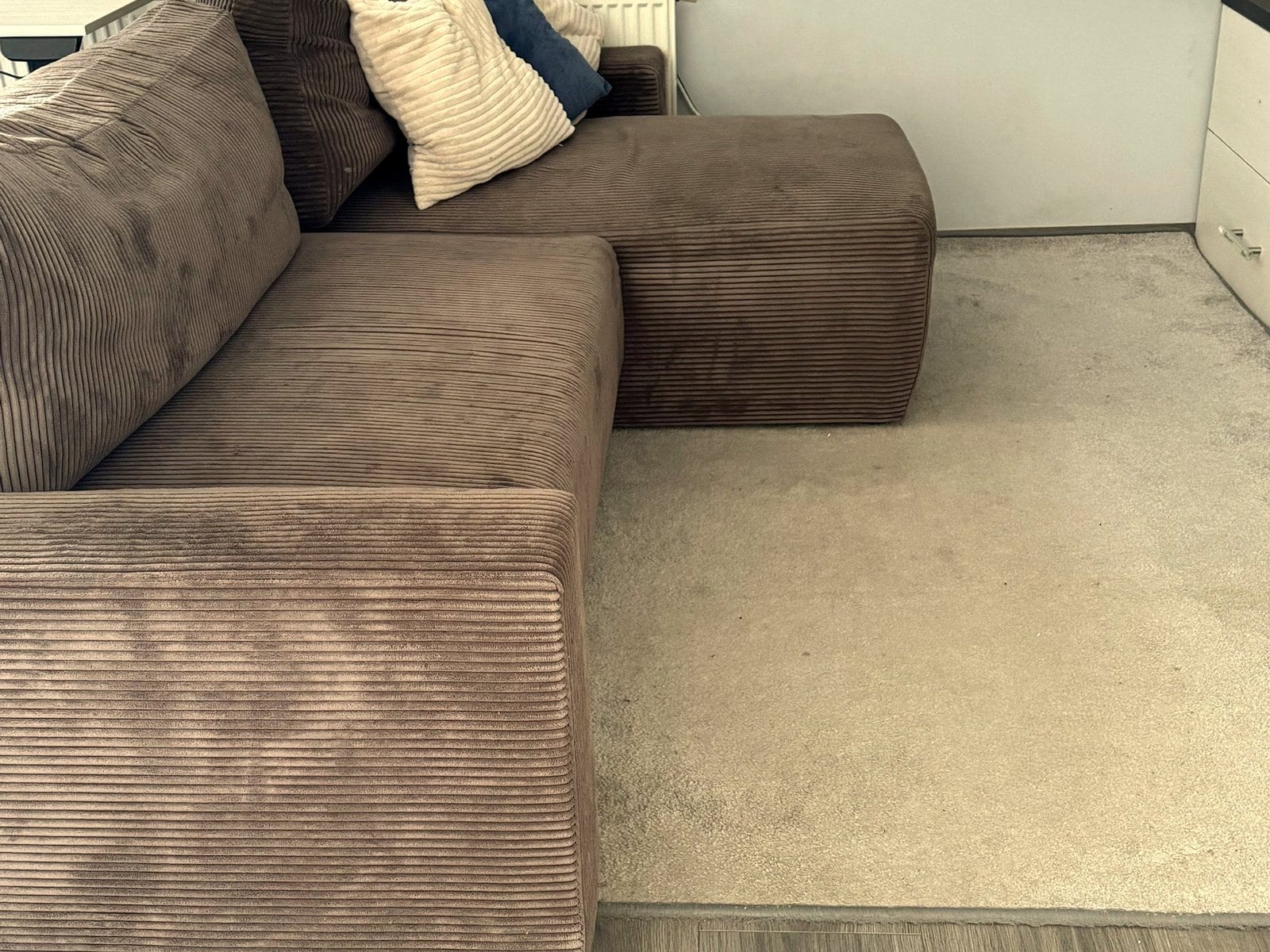
Here’s a real one-room apartment living room, not a staged photo, and it shows the most common small-space rug problem perfectly. The L-shaped corduroy sectional has its chaise fully on a soft gray shag rug, which is exactly right. But the long side of the sofa runs past the rug’s edge, so the arm ends on bare floor. And on the other side, the rug runs right up to the TV dresser, because in a one-room apartment there’s simply no space for a border there.

If your living room looks like this, you don’t need to start over. Here’s how I’d fix it, from the cheapest option to the most effective:
- Slide the rug toward the long side. Center it on the main sofa instead of on the chaise, so the front edge of the seat lands on the rug too. The chaise will overlap a little less, and that’s fine. It’s free and takes two minutes.
- Layer a longer flat rug underneath. A flat-woven jute rug that reaches past the sofa arm does the sizing job, and the soft shag stays on top where your feet land. This is my favorite fix, because you keep the rug you already like.
- When you replace it, go longer, not deeper. The depth here already works: the rug fills the gap between sofa and dresser. A deeper rug would push under the dresser and start to look like badly fitted carpet. One size longer, same depth, is the upgrade that actually changes the room.


The small-room rule: in a tight living room, size the rug to the sofa’s long side first and let the rug touch furniture on the other sides if it has to. A rug that’s long enough but snug looks intentional. A rug that’s short looks like an accident.
The Rugs I’d Actually Buy (and What to Skip)
Size first, then everything else. Each of these comes in the standard sizes from the chart above, so pick the size first and the style second. I care more about a rug that forgives daily life than one that photographs perfectly, and that shaped every pick here.
My pick for most living rooms
SAFAVIEH Madison Collection Boho Vintage Rug
A soft, faded vintage pattern in cream with muted color, low pile and non-shedding. The distressed look is the clever part: crumbs, paw prints and a coffee drip simply disappear into it. It’s the rug I’d choose for a cozy boho living room that’s actually lived in, and the listing offers several sizes, so pick yours from the size menu.
Worth it if: you want a warm, collected look that hides everyday mess, especially in an 8×10 or 9×12.
Skip it if: you need to throw the whole rug in the washing machine. Then the washable pick below is the better fit.

For pets, kids and spills: Soalmost Washable Rug
A soft, neutral living room rug in beige, with a non-slip backing that’s made to be washed. If you have a dog, a toddler or a habit of eating dinner on the sofa, this is the one I’d reach for. Check the care label and your washer’s capacity before you order the largest sizes: a big rug needs a big drum. See the washable rug on Amazon

Want it washable? An 8×10 rarely fits a home washer, so check the drum before you buy. I compared which sizes actually fit, and when a two-piece cover and pad beats a one-piece rug, in the best washable rugs for a living room.
For natural texture: nuLOOM Rigo Jute Rug
Hand-woven jute in a natural tone. A jute living room rug is the classic base for a relaxed, earthy room and the rug I’d use underneath when layering. It’s honest about what it is, though: jute and water don’t get along, so I’d skip it with a puppy in the house. If an accident does happen, here’s why the usual dog pee advice makes jute worse. See the jute rug on Amazon
Don’t forget: a rug pad in the same size
A felt and rubber pad keeps the rug from creeping and makes a thin rug feel twice as soft underfoot. Order it in the same size as the rug; it should end up about an inch shorter on every side, and if it isn’t, a felt pad is easy to trim with sharp scissors. Whether you need one at all depends on your floor, and I broke that down in The Rug Pad Question Is Really Four Questions. See the felt and rubber rug pad on Amazon
When Your Rug Is Too Small, and When It’s Time to Replace It
If you’re reading this because the rug you already own suddenly looks tiny, you’re in good company. A too-small rug is the most common sizing mistake in a living room, and it’s fixable without starting over:
- Layer it. A larger flat jute or sisal rug underneath gives the room the size it needs and keeps the rug you love on top.
- Switch layouts. Pull the furniture off the rug completely and float it under the coffee table. A slightly small rug looks far better with no legs on it than with two legs half on.
- Move it. A 5×8 that’s too small for the living room is often perfect in a bedroom, beside the bed, or in an entryway.
Replace the rug instead when it’s worn thin in the walkways, when the backing crumbles or the corners keep curling no matter what you try, or when it sheds so much that you vacuum fibers every day. Curling, by the way, often has a cause you can fix first; here’s how to diagnose curling rug corners before you buy anything. When you do replace it, it’s the perfect moment to go up a size.
Rug Size Calculator for Your Living Room
Enter your sofa length and your room size, and choose a layout. The calculator checks every standard US rug size against both rules: wider than the sofa, with at least a foot of floor to the walls.
Questions People Ask
Should the rug go under the coffee table?
Yes. In every layout, the coffee table sits fully on the rug, with all four legs on. A coffee table hanging half off the edge is one of the quickest signs that a rug is too small.
Can you put an area rug on top of carpet?
You can, and it’s a great way to add warmth and pattern in a carpeted rental. Choose a low-pile or flat-woven rug so it doesn’t shift, and use a pad made for rug-on-carpet, not the rubber kind meant for hard floors.
What size rug for a living room and dining room in one space?
Treat them as two zones with two rugs. The living rug follows the sofa rules above, and the dining rug should extend about 2 feet past the table on every side, so chairs stay on it when pulled out. Keep the two rugs in the same color family so the space still feels connected.
Does the rug have to match the shape of the room?
No, it has to match the shape of the seating. In a long, narrow living room, the rug follows the sofa, which usually means the rug’s long side runs along the room’s long wall. In a square room with a square seating group, a square or nearly square rug can look better than a rectangle.
Is a bigger rug always better?
Only up to the point where the border disappears. A rug that runs under the TV console, against the walls or into the walkway starts to look like badly fitted carpet. When the next size up would do that, stay with the smaller rug and get the layout right instead.
Want these sizes on one page?
My free Rug Size Cheat Sheet has the sofa-to-rug sizes from this guide, plus the bedroom, dining room and hallway rules. Print it and take it shopping.
Get the free cheat sheetFree printables, first
Want my next printable and new cozy guides in your inbox? One short email when something new is out, no spam, unsubscribe anytime.
The Bottom Line
The right size rug for a living room isn’t a mystery number. Let the sofa set the minimum and the walls set the maximum, then choose the biggest standard size in between. For most homes that’s an 8×10 with the front legs on. If the room is small, a 6×9 or a floating rug works; if it’s large or open, a 9×12 or bigger pulls the seating together. And if you’re stuck between two sizes, tape both on the floor before you buy. Your eye will decide in about five seconds.
Sources
Keep reading
- The Rug Pad Question Is Really Four Questions
- Rug Corners Curling Up? Diagnose the Cause Before You Buy Anything
- Rug Tape and Your Floor: Read the Adhesive, Not the Brand
- Dog Pee on a Jute Rug: Why the Usual Advice Makes It Worse
- How to Mix Patterns and Colors in Eclectic Boho Interiors Without Overwhelm
- How to Hang Curtains: Measure the Height First, Then Buy the Length
Meet Sofie
Hi, I’m Sofie, the voice behind Cozy Home Vibes. I write for people who want a home that feels warm and lived-in without a designer budget. Before I recommend anything, I read the size charts, care labels and manufacturer fine print, so you can skip that part and get straight to the cozy.


Leave a Reply