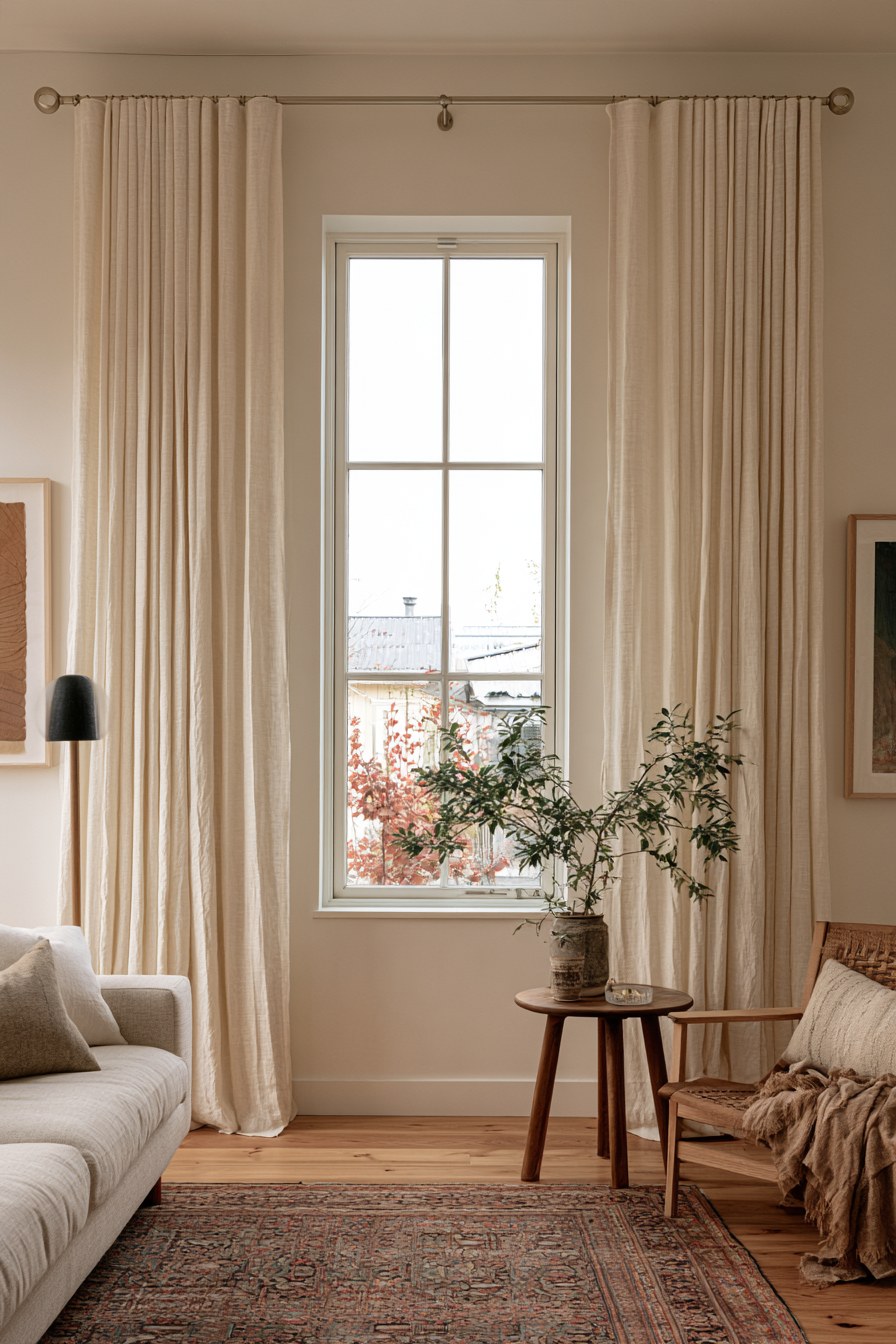
Most guides on how to hang curtains give you the rules one at a time: hang the rod high, make it wide, let the fabric touch the floor. Then you go shopping, and the 84-inch panels in your cart quietly undo the first rule. The trick is the order. Choose the rod height first, then the rod length, then the panel width, and only then the panel length. Do it the other way round, and the curtains end up deciding where your rod goes.
Short answer: To hang curtains so a window looks bigger, mount the rod at least 4 inches above the window frame, and higher if the ceiling allows. Let the rod run 8 to 10 inches past the frame on each side, so open curtains stack on the wall instead of the glass. Buy panels that add up to 2 to 2.5 times the rod length, then measure from the floor to the point the panel will hang from and choose the standard length that just skims the floor. On an 8-foot ceiling, that usually means 95- or 96-inch panels, not 84.
Disclosure: this post contains affiliate links, and as an Amazon Associate I earn from qualifying purchases. If you buy through them I may earn a small commission at no extra cost to you. I only recommend things I would use in my own home.

How to Hang Curtains: Measure in This Order
Start at the top. Every other measurement depends on how high the rod goes, so that’s the decision you make first. The rest is simple arithmetic.
- Rod height. Mark the spot on the wall where the rod (or the top of the panel) will sit. Higher makes the window look taller.
- Rod length. Measure the window frame from outside edge to outside edge, then add the extension on both sides.
- Panel width. Multiply the rod length by your fullness factor and divide by the width of one panel. That tells you how many panels to buy.
- Panel length. Measure from the floor to your hanging point and pick the standard length that fits the look you want.
Honestly, I’d rather see someone buy one less pillow and spend it on longer curtains. Nothing makes a room look finished faster than drapes that start high and end on the floor, and nothing makes it look more temporary than panels that stop halfway down the wall.
Numbers worth knowing
- 4 inches: the minimum height above the window frame; go higher, up to a few inches below the ceiling, if the panels allow it
- 8 to 10 inches: how far the rod should extend past the frame on each side, so the curtains clear the glass when open
- 2 to 2.5x: the total width of your panels compared with the rod length; sheers and linen look best near 2.5x
- 63, 84, 95 or 96, 108, 120 inches: the standard US panel lengths
- About ½ inch: the gap between hem and floor for curtains that just skim it; add 1 inch for a soft break, 3 to 6 inches for a puddle
- The ring drop: clip rings and hooks lower the panel below the rod, so measure one ring before you choose the length
Quick quiz
Which curtain setup fits your window?
Three questions. For exact numbers, use the calculator further down.
How High to Hang Curtains
The usual rule is to hang curtains at least 4 inches above the window frame. That’s a minimum, not a target. If there’s wall above the window, I’d go closer to the ceiling, roughly halfway between the frame and the ceiling or higher. The eye reads the curtain as the window, so a rod mounted high makes a short window look tall.
There’s one catch. The higher the rod goes, the longer the panels have to be. That’s why, when you hang curtains, you mark the height first and buy the panels second, never the other way around.
How Wide Should Curtains Be?
Curtains need extra fabric to look full when closed. A panel that is exactly as wide as the window looks flat and stretched, like a sheet pinned to the wall. For a soft, gathered look, the panels together should be about twice the rod length. Sheers and lightweight linen can go fuller, closer to two and a half times.
Here’s how that works in practice. Say your window frame is 36 inches wide and you extend the rod 9 inches on each side. The rod is 54 inches, so you want about 108 inches of fabric in total. Most ready-made panels are 50 to 55 inches wide, so that’s two panels. For a 60-inch window, the rod becomes 78 inches and you’d need three or four panels, depending on how full you like them.
How Far Past the Window Should a Curtain Rod Go?
This is where the guides disagree, and it’s worth knowing why. When curtains are open, the fabric bunches up at each end of the rod. Designers call that the stack-back. If the rod ends right at the frame, the stack covers part of the glass and you lose daylight. Hang curtains on a longer rod and the open panels rest on the wall instead.
Source check
Pottery Barn places the brackets 1 to 3 inches outside the frame. The Home Depot extends the rod 8 to 10 inches past the frame on each side.
Both work, but for different goals. A short extension frames the window neatly and suits narrow walls or windows close to a corner. A long one keeps the stack-back off the glass and makes the window look wider.
My pick: go wide whenever the wall allows it. Light is the whole point of a window, and a cozy room still needs daylight. Go short only when a corner or a door leaves no room.
To find the rod length, measure the frame from the outside edge on one side to the outside edge on the other, then add the extension twice. Buy an adjustable rod whose range puts that number near the middle, not at the very end. A rod pulled out to its maximum tends to sag in the middle, and you’ll want a center support bracket for anything much over 6 feet.

What Length Curtains Do You Need?
Measure from the floor up to the point where the panel will hang. With a rod pocket or grommets, start from the top of the rod; grommet panels then hang about an inch and a quarter shorter than their label, because the grommet sits below the top edge. With clip rings or hooks, it’s the bottom of the ring, because the ring hangs below the rod. Then pick the closest standard length for the look you want.
The 84-inch trap
The 84-inch panel is everywhere, and it’s often the wrong one. In a room with a standard 8-foot ceiling, a typical window frame tops out around 80 to 82 inches from the floor. An 84-inch panel forces the rod down to just above the frame, which is exactly the low, squat look you were trying to avoid.
Now the worked example. The ceiling is 96 inches. Leave room for the brackets and the rod ends up around 93 to 94 inches from the floor. With a rod pocket, that is your hanging point, and a 95-inch panel just reaches the floor. Grommet panels hang a little shorter, so the same 95-inch panel floats just above it. With clip rings, the panel drops another inch or so below the rod. If you want a true skim instead, fold the top inch of the panel over before you clip the rings on. It’s invisible from the room and saves you hemming. An 84-inch panel in the same room would leave the hem hanging 9 or 10 inches above the floor, or pull the rod down to the frame.
If you hang curtains in a room with 9-foot ceilings or higher, look at 108-inch panels. And if you can’t find the exact length, buy longer rather than shorter. A panel that’s an inch too long can be hemmed or raised with the rings; one that’s too short can only gain an inch or two from clip rings or a lower rod. For every standard length, the shrinkage trap and a calculator that adjusts for grommets and rings, see my guide to how long curtains should be.
Skim, break or puddle?
A skim, with the hem hovering just above the floor, is the easiest to live with. It doesn’t collect dust or get caught by the vacuum. A soft break, where the fabric just touches the floor, looks a little more relaxed and suits linen. A full puddle looks romantic but collects dust, so I’d save it for a window nobody opens.

The Curtain Hanging Kit: What to Buy
You don’t need all of this. Pick the rod that suits your wall, the panels that suit your light, and add the small parts only if your setup calls for them.
| Piece | Worth it if | Skip if |
|---|---|---|
| Adjustable rod, 72 to 144 inches | You want to extend well past the frame | The window sits in a recess and the rod goes inside |
| Double rod | You want sheers by day and darker panels at night | One layer is enough for your light and privacy |
| No-drill trim brackets | You rent and the window has wooden trim | The trim is oak, MDF, PVC or metal, or the setup weighs over 20 pounds |
| Linen-look panels, 95 or 96 inches | You have an 8-foot ceiling and want soft, filtered light | You need a dark bedroom for sleep |
| Sheer linen panels | You want privacy without losing daylight | The window faces a street at night with the lights on |
| Blackout linen-look panels | It’s a bedroom, nursery or media room | It’s a living room you want bright during the day |
| Clip rings | Your panels are flat or a little short, or you open them daily | Your panels already have grommets |
For most windows: Umbra Cappa Adjustable Curtain Rod
A simple adjustable rod with round finials that runs from 72 to 144 inches, so one size covers most single windows with room to extend past the frame. Check the rod diameter against your clip rings before you buy both. See the Umbra Cappa rod on Amazon
For 8-foot ceilings: NICETOWN Linen-Look Curtains, 96 Inches
A pair of faux linen panels, 55 inches wide and 96 inches long, with both a rod pocket and back tabs. That length is the one most 8-foot rooms actually need, and the textured weave gives you the relaxed linen look without the wrinkles of real linen. They filter light rather than block it. See the linen-look curtains on Amazon
For renters: Kwik-Hang No-Drill Curtain Rod Brackets
Brackets that tap into the top of a wooden window casing, so you get a rod above the window with no holes in the wall. Read the limits before you order: a wooden casing between half an inch and one inch wide, and no more than 20 pounds of rod and fabric. For long rods, there’s a set with a center support as well. See the Kwik-Hang brackets on Amazon
The rest of the kit: the Cappa double rod for layering, sheer linen grommet panels, blackout linen-look panels and 1.5-inch clip rings.
Ways to Hang Curtains: Rings, Grommets, Tabs and Pockets
How you hang curtains on the rod decides how they move and how much length you lose. Many ready-made panels offer two styles, such as a rod pocket and back tabs.
- Clip rings. Clip onto any flat panel and glide easily. They add drop below the rod, which helps if your panels are a little short. My favorite for curtains you actually open and close.
- Grommets. Metal rings built into the fabric. They slide well and make deep, even folds, but they look more casual and show the rod.
- Back tabs. Hidden loops on the back that make neat, tailored pleats. They slide less easily, so they suit curtains that stay mostly put.
- Rod pocket. The rod runs through a sewn channel. It’s the cheapest option and gathers nicely, but it barely moves. Good for sheers you rarely touch.
- Pinch pleat with hooks. The tailored look of custom drapes. The hooks go into rings or a track, so check the drop before you buy.
One thing to check with clip rings: the inner diameter has to clear your rod. A ring made for a 1-inch rod won’t slide over a thicker one, and you’ll only find out when you’re on the ladder.

How to Hang Curtains Without Drilling
Renting, or living with walls you’d rather not patch? You can still hang curtains high and wide. There are three honest options, and each has a limit.
- Brackets that press into the window trim. Kwik-Hang brackets tap into the top of a wooden window casing without screws. The maker’s limits matter here: the trim should be a traditional wooden casing (not hardwood like oak, and not PVC, MDF, metal or crown molding), between half an inch and one inch wide, and the load tops out at 20 pounds. They take a 5/8-inch or 1-inch rod.
- A tension rod inside the frame. Works anywhere the frame has two solid sides. The trade-off is that the curtains cover the glass and the window looks smaller.
- Adhesive hooks. Fine for a featherweight sheer or a café curtain, but I wouldn’t trust them with lined or blackout panels.
If you have the choice, the trim brackets give you the high, wide look without drilling; all they leave is a few tiny pin holes in the top of the trim. To match the right hardware to your own window, including magnetic rods for steel doors, read my guide to choosing a no drill curtain rod. For more ideas that come off cleanly when you move out, see my no-damage Scandinavian decor for renters and the guide to peel-and-stick wallpaper for renters.

Quick Curtain Calculator
Before you hang curtains, put in your own numbers and get the rod length, the number of panels and the standard length to buy. Measure in inches. For grommet and ring drop, linen shrinkage and where the hem will actually land, use my full curtain size calculator.
Curtains Already Up? Find the Fix in 3 Taps
If your curtains are hung but something looks or works wrong, this points you to the one part that fixes it.
Curtain Hanging Questions
Should curtains touch the floor?
In most rooms, yes, or nearly. Hang curtains so the hem skims the floor unless something is in the way. Floor-length curtains make the ceiling look higher and the room look finished. The exception is a window over a radiator, a window seat or a kitchen counter, where sill-length or apron-length panels are the practical choice.
How close to the ceiling can you hang a curtain rod?
As close as the brackets and finials allow, which usually means 1 to 3 inches below the ceiling or crown molding. Leave enough room to lift the rod onto the brackets. Ceiling-mounted tracks are the other option if you want the fabric to start right at the top.
What size curtains for an 8-foot ceiling?
Usually 95 or 96 inches, with the rod mounted near the ceiling. Measure from the floor to your rod first, though, because the right answer depends on where the rod actually sits and whether you use clip rings.
Do you measure curtains from the top of the rod or the bottom of the rings?
It depends on the top of the panel. For grommets and rod pockets, measure from the top of the rod. For clip rings and hooks, measure from the point where the panel actually hangs, which is lower.
Can you hang curtains on a window with no wall space above it?
Yes. Use ceiling brackets or a ceiling-mounted track, or a tension rod inside the frame. In that case, focus on width: extending the rod past the sides makes the biggest difference when you can’t go higher.
Free printable
Take the measurements to the store with you
My Curtain Measuring Cheat Sheet has the diagram, the four measurements in order, blanks for up to three windows and the standard lengths. One US Letter page.
 Get the free cheat sheet
The Bottom Line
To hang curtains well, do the steps in the right order. Mark the rod height first, as high as your wall and panels allow. Then extend the rod past the frame so the open curtains rest on the wall. Buy enough fabric to look full, and only then choose a length, measured from the floor to wherever the panel really hangs. Get the height right, and the 84-inch question answers itself. If you’re working on the whole room, the same measure-first thinking applies to choosing a rug size and hanging a mirror.
Sources
Keep reading
- No Drill Curtain Rods: Pick the One That Fits What’s Around Your Window
- How Long Should Curtains Be? The Number on the Package Isn’t Where the Hem Lands
- Curtains for Small Windows: What’s Below the Window Decides the Length
- Linen Curtains: Real, Blend or Faux? Match Them to the Window, Not the Photo
- How to Layer Sheer and Blackout Curtains: Which Goes in Front Depends on the Room
- Boho Curtains: Choose Pattern, Texture or Trim, Not All Three
- Scandinavian Living Room Ideas: Minimalist Comfort with Hygge Vibes
- Small Bedroom Ideas Cozy: How to Create a Warm and Stylish Small Space
- Measure the Shade, Then Check the Fitter: Lamp Shade Sizing Without the Returns
- Scandinavian Lighting Guide: Create a Cozy Hygge Glow
- Free Rug Size Cheat Sheet: A Printable Rug Size Chart for Every Room


Leave a Reply