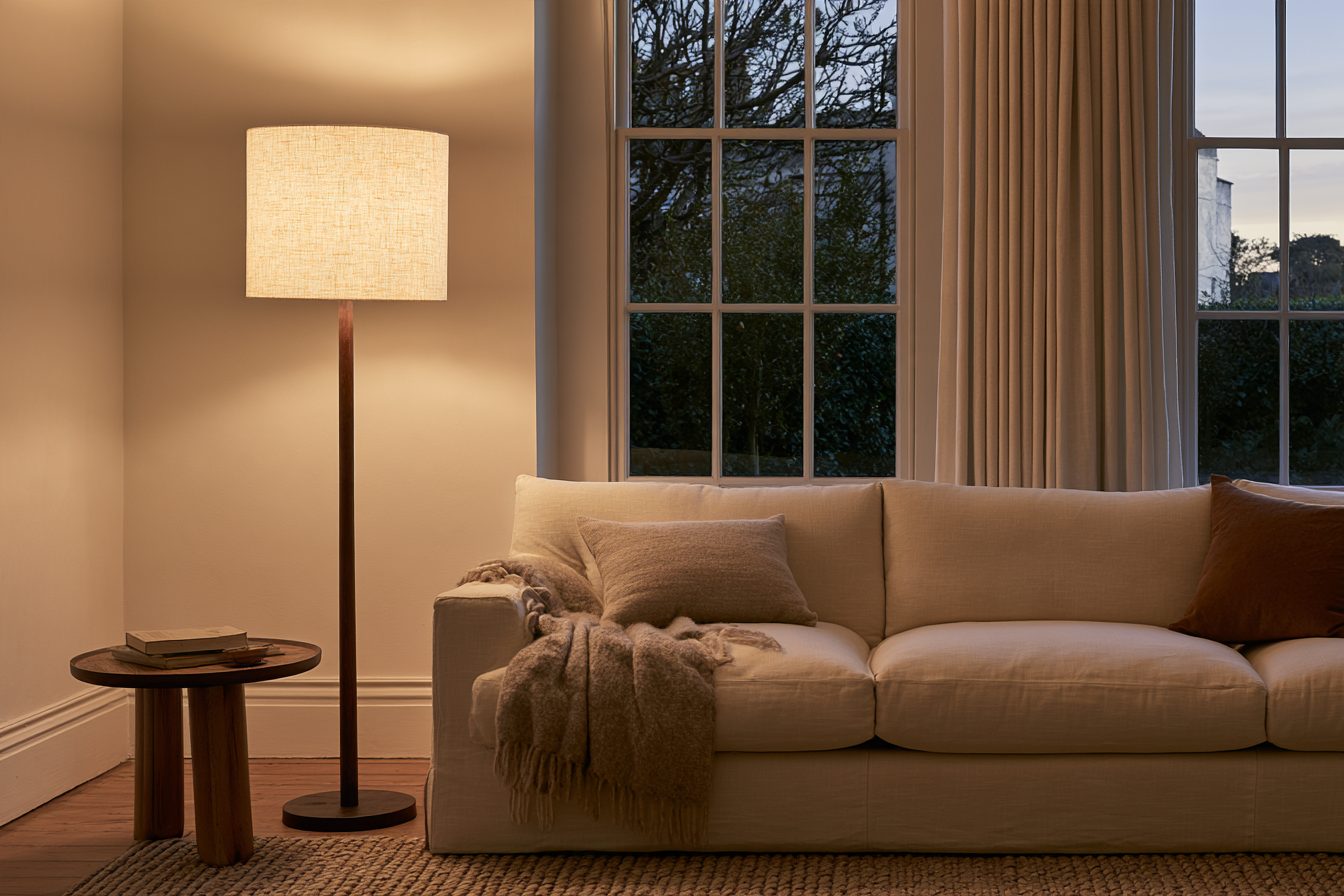
A floor lamp for the living room is the easiest way to swap a flat ceiling light for a warm evening glow. Most guides start with style, then quote one height for every lamp. But the number that decides whether a floor lamp glares or glows is not the lamp’s height. It is where the bottom of the shade sits compared with your eyes when you are sitting down.
So this guide starts with that measurement, then turns it into a lamp height, a bulb and a spot next to the sofa. It is the first in my series on living room lighting.
Short answer: Sit on your sofa and measure from the floor to your eyes. The bottom of the shade should land close to that height: 1stDibs says “slightly below or approximately at” eye level, and Visual Comfort says “at or just above.” Most floor lamps are 58 to 64 inches tall, according to 1stDibs; Visual Comfort suggests 50 to 60 inches for lower ceilings and 65 to 80 for high ones. Place the lamp slightly behind you or to one side, and pick the bulb by lumens: ENERGY STAR lists 800 lumens as a 60 watt replacement and 1,600 as a 100 watt one.
Disclosure: this post contains affiliate links, and as an Amazon Associate I earn from qualifying purchases. If you buy through them I may earn a small commission at no extra cost to you. I only recommend things I would use in my own home.
How Tall Should a Floor Lamp Be?
Start with the published ranges, then adjust them to your sofa. 1stDibs puts it simply: a floor lamp “should typically be between 58 and 64 inches tall.” Visual Comfort ties the height to the room instead.
| Situation | Lamp height | Source |
|---|---|---|
| Typical living room | 58 to 64 inches | 1stDibs |
| Lower ceilings | 50 to 60 inches | Visual Comfort |
| High ceilings | 65 to 80 inches | Visual Comfort |
| Shade bottom | At or near your seated eye level | 1stDibs and Visual Comfort |
Heights are overall, floor to top. Ranges are from the sources named in each row.
Still, notice that the ranges overlap a lot. A 60 inch lamp can be right or wrong depending on how low your sofa is and how tall the shade is. That is why the shade bottom matters more than the total.
Source check: “the shade should sit at eye level”
What the internet says: Put the bottom of the shade exactly at eye level.
What the sources say: 1stDibs says “slightly below or approximately at the eye level of a person sitting nearby.” Visual Comfort says “at or just above eye level when you sit near it.” So one source leans low and the other leans high.
What I’d do: Aim for eye level, then test. If you can see the bulb from your seat, the shade is too high or too narrow. If the light pools only on your lap and the room stays dark, it is too low. A range of an inch below to about two inches above covers both sources.

Calculator
What Height Floor Lamp Fits Your Sofa?
Sit the way you usually do and have someone measure from the floor to your eyes. The shade height is on the lamp listing.

Where to Put a Floor Lamp in the Living Room
Visual Comfort’s advice for a reading lamp is to have it “stand slightly behind you or to one side.” That keeps the light on the page and out of your eyes. Beyond the reading spot, these are the placements I would use.
| Spot | What it does | Best lamp type |
|---|---|---|
| Beside the arm you read on, slightly behind | Task light for books and knitting | Adjustable arm or swivel head |
| Behind a sectional or a sofa off the wall | Soft background glow | Drum shade or uplight |
| In a dark corner | Makes the room feel wider | Uplight or tall drum shade |
| Over the sofa from the side | Reading light without a side table | Arc lamp; check the reach |
| Next to the TV | Cuts the contrast of a bright screen | Low, dimmable lamp |
Reading placement and arc lamp note from Visual Comfort; the rest is my take.
Visual Comfort also notes that thin or arc designs give “ample light without obstructing movement around the sofa.” In a small room that matters more than the lamp’s look. My tiny living room ideas have more on keeping walkways clear.

Lumens, Not Watts: Picking the Bulb
Bulbs are now sold by lumens, the amount of light they give. ENERGY STAR lists the minimum lumens that replace the old incandescent bulbs.
| Old bulb | Minimum lumens | Where I’d use it |
|---|---|---|
| 40 W | 450 | Accent lamp, background glow |
| 60 W | 800 | Most floor lamps in a cozy room |
| 75 W | 1,100 | A reading lamp, or a bright drum shade |
| 100 W | 1,600 | Reading in a dark room, or one lamp lighting a whole corner |
Lumens from ENERGY STAR. The last column is my take.
Before you buy, check two labels. The lamp has a maximum wattage, and the bulb box lists the actual watts it uses. An LED that matches a 100 watt bulb uses far fewer watts, so read the real number on the box, not the equivalent.
For color, I stay at 2700K in a living room for the warm, golden evening look I describe in my Scandinavian lighting guide. A dimmable bulb, with a lamp that supports dimming, gives you both reading light and a soft glow.

The Shade Changes Everything
Even the same lamp reads differently with a different shade. For example, a drum shade spreads light sideways into the room. A tapered or empire shade pushes more of it down. An opaque shade makes a pool of light, while a linen one glows.
If you are replacing a shade on a lamp you already own, measure the old one first and check the fitter. My guide on how to measure a lamp shade walks through it. A taller or shorter shade also moves its bottom edge, so check the new one against the calculator above.

What I’d Look For in a Floor Lamp
Best for reading
Floor lamp with an adjustable arm or swivel head
You can aim the light at the page and away from the TV. Check the height at the lowest and highest settings against the calculator above.
Worth it if: you read or knit on the sofa.
Skip it if: you only want background glow; then a fixed drum shade looks calmer.
Best for a corner
Tall drum shade floor lamp
A linen drum shade spreads light sideways and makes a dark corner feel lived in. Check the shade height to land the bottom near eye level.
Worth it if: one corner of your room stays dark at night.
Skip it if: the only spot is right beside your face; then a lamp with a directed head suits you better.
Best without a side table
Arc floor lamp
An arc reaches over the sofa so you get light from above without a table. Measure how far it reaches and how much floor the base needs.
Worth it if: your sofa floats in the room or sits under a window.
Skip it if: your walkway is tight; the base and the arc both take space.
Bulb
Warm white dimmable LED, 2700K
Often one good bulb is all a harsh lamp needs. Pick the lumens from the table above and check the actual watts against the lamp’s maximum.
Worth it if: your lamp feels too bright or too cold.
Skip it if: your lamp has a built-in LED; then you cannot change the bulb.

When a Floor Lamp Isn’t the Best Choice
- Your sofa is against the wall with no gap. There is no room behind you. A wall-mounted swing-arm light gives the same angle without floor space.
- Toddlers or big dogs run through the room. A tall lamp on a small base can tip. Use a heavy base, or a table lamp on a sturdy side table.
- You want the whole room bright. One floor lamp is a layer, not a ceiling light. Combine it with other lamps, as in my tiny home lighting guide.
- You love an industrial look. Pendants and exposed bulbs may suit you better; see my loft lighting ideas.
Questions People Ask
How far should a floor lamp be from the sofa?
Close enough that the shade sits just beside or slightly behind your shoulder. Visual Comfort describes it as slightly behind you or to one side; a few inches from the sofa arm usually does it.
How many floor lamps does a living room need?
Usually one or two, mixed with table lamps. Light at different heights around the room feels cozier than one bright lamp in a corner.
Can a floor lamp go behind the sofa?
Yes, if the sofa sits away from the wall. Visual Comfort mentions placing one behind a sectional for a balanced glow. Make sure the shade clears the sofa back.
Are arc lamps good for reading?
They can be, if the shade hangs at a comfortable height above and slightly beside you. Check the listing for the shade height at full reach.

Free printable
Free Cozy Home Starter Checklist
Working through your living room one layer at a time? This one-page checklist covers lamps, textiles and the small things that make a room feel warm.
Get the free checklistThe Bottom Line
Choosing a floor lamp for the living room starts with you, not the lamp. Measure your seated eye height and set the bottom of the shade close to it; 1stDibs and Visual Comfort differ only on whether that is a touch below or a touch above. Most lamps are 58 to 64 inches tall. Place it slightly behind you or to one side, use 800 lumens for glow and 1,100 to 1,600 for reading, and keep the color at a warm 2700K.
Sources
Last checked November 14, 2026: floor lamp heights and placement (Visual Comfort, 1stDibs), lumens per incandescent equivalent (ENERGY STAR).
Keep reading
- Measure the Shade, Then Check the Fitter: Lamp Shade Sizing Without the Returns
- Scandinavian Lighting Guide: Create a Cozy Hygge Glow
- Tiny Home Lighting: How to Make a Small Space Feel Brighter and Bigger
- Cozy Reading Nook Ideas: 15 Hygge Corners
- Scandinavian Living Room Ideas: Minimalist Comfort with Hygge Vibes
- The Rug Should Fit the Sofa, Not the Room: What Size Rug for a Living Room
Meet Sofie
Hi, I’m Sofie, the voice behind Cozy Home Vibes. I write for people who want a home that feels warm and lived-in without a designer budget. Before I recommend anything, I read the size charts, care labels and manufacturer fine print, so you can skip that part and get straight to the cozy.
Free printables, first
Want my next printable and new cozy guides in your inbox? One short email when something new is out, no spam, unsubscribe anytime.


Leave a Reply